護理風險管理在神經內科病房中的應用價值體會
2020-06-22 13:04:45顏笛玉周巧
中國衛生產業
2020年5期
關鍵詞:風險管理
顏笛玉 周巧

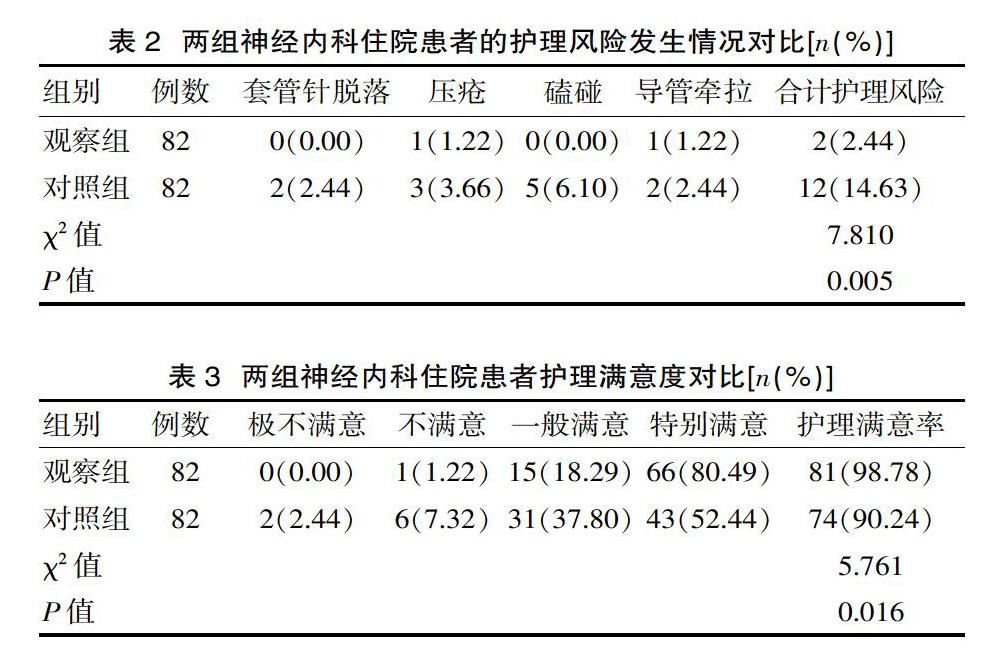
[摘要] 目的 探討護理風險管理在神經內科病房中的應用價值。方法 選取2017年6月—2019年5月該院收診的164例神經內科住院患者,按照實施管理階段分為觀察組(護理風險管理)82例與對照組(傳統護理管理)82例,比較2組護理服務質量評分(消毒隔離、病房管理、基礎護理),護理風險發生率,護理滿意度指標。結果 治療結束,觀察組護理服務質量評分(消毒隔離、病房管理、基礎護理),護理風險發生率(2.44%),護理滿意度(98.78%)均優于對照組,差異有統計學意義(P<0.05)。結論 護理風險管理方法可有效提高神經內科住院患者護理服務質量與護理滿意度,減少其護理風險發生情況。
[關鍵詞] 神經內科;護理管理;風險管理
[中圖分類號] R473.74 [文獻標識碼] A [文章編號] 1672-5654(2020)02(b)-0024-03
[Abstract] Objective To explore the value of nursing risk management in neurological wards. Methods A total of 164 inpatients of neurology who were admitted to the hospital from June 2017 to May 2019 according to implementation management phase divided into the observation group (nursing risk management) 82 cases and the control group (traditional nursing management) 82 cases. Two groups of nursing service quality scores (disinfection and isolation, ward management, basic care), incidence of nursing risk, and nursing satisfaction indicators were compared. Results After the treatment was completed, the observation group's nursing service quality scores (disinfection and isolation, ward management, and basic care), the incidence of nursing risk(2.44%), and nursing satisfaction(98.78%) were better than the control group with significant differences(P<0.05). Conclusion Nursing risk management method can effectively improve the nursing service quality and nursing satisfaction of inpatients in neurology department, and reduce the occurrence of nursing risk.
[Key words] Neurology; Nursing management; Risk management
醫院病情較為復雜的科室之一即為神經內科,其發病群體多為腦梗死、腦出血、腦部炎癥、偏頭痛等腦部疾病者[1],風險發生情況相對較多。為改善上述問題,目前常采用護理風險管理方法對神經內科住院患者進行輔助管理,可在保證患者護理滿意度、減少患者感染率的同時提升其護理有效性[2]。該文選取2017年6月—2019年5月該院收治的164例神經內科住院患者,系統分析、研究護理風險管理方法在神經內科住院患者治療中的應用價值,報道如下。
1? 資料與方法
1.1? 一般資料
選取該院收診的神經內科住院患者,總計入組164例,按護理管理方法不同,分為觀察組(82例,)與對照組(82例)。觀察組中,女36例,男46例;年齡24~75歲,平均為(48.35±6.93)歲。對照組中,女34例,男48例;年齡21~76歲,平均為(48.87±6.84)歲。比較上述一般資料,差異無統計學意義(P>0.05)。納入標準:精神正常、神志清楚。164例研究對象均經醫學倫理委員會批準且患者已知情同意。排……
登錄APP查看全文
猜你喜歡
世界最新醫學信息文摘(2021年12期)2021-06-09 08:37:56
現代經濟信息(2020年34期)2020-06-08 06:02:18
商周刊(2018年23期)2018-11-26 01:22:28
消費導刊(2018年10期)2018-08-20 02:57:02
中國衛生標準管理(2015年1期)2016-01-14 03:41:26
當代經濟(2015年4期)2015-04-16 05:57:02
現代企業(2015年6期)2015-02-28 18:52:13
無錫職業技術學院學報(2014年2期)2014-02-28 17:53:16
黨政干部論壇(2014年3期)2014-02-27 09:19:21
中國工程咨詢(2014年8期)2014-02-16 06:31:00