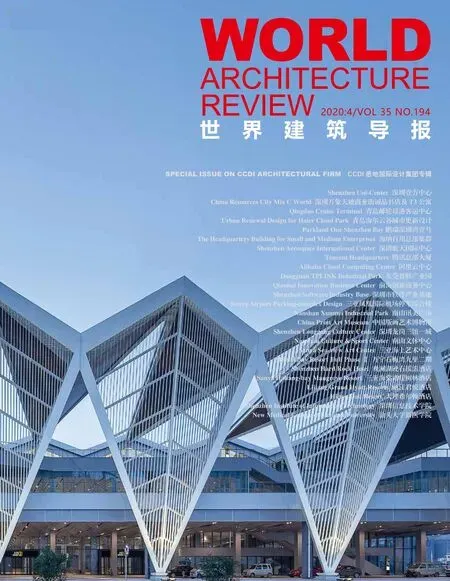
阿里云中心
2020-09-07 06:45:54
世界建筑導報 2020年4期
業主:阿里巴巴集團
地點:深圳市南山區科苑北路
用地面積:16 292平方米
建筑面積: 110 435平方米
建筑高度:69米
結構形式:鋼筋混凝土框架-核心筒結構
建筑設計: CCDI 悉地國際
結構設計/機電設計: CCDI 悉地國際
設計/竣工: 2011/2015年
Client: Alibaba Group
Location: North Keyuan Road, Nanshan District, Shenzhen, China
Site Area: 16,292 m2
Floor Area: 110,435 m2
Height: 69 m
Structural Form: Reinforced Concrete Frame - Core Tube Structure
Architectural Design: CCDI
Structural Design/M&E Design: CCDI
Design/Completion: 2011/2015
阿里云中心占據了一個完整的城市街區,建筑的容積率和高度被規劃導則控制在更加適合步行體驗的范疇。建筑三面圍合,面向海灣開敞,延續了街道的秩序感。但建筑界面并不死板,建筑體塊通過“堆疊”的方式,改變現有城市的尺度感與天際線。堆疊的體量把大尺度的建筑分解成一個個看似隨意疊加的方盒子,使建筑形體消解在了城市背景之中。小尺度的疊加一方面與阿里巴巴致力服務于中小企業的理念相同,另一方面這種有趣而豐富的形態也更平易近人,比起精英派的高層寫字樓更具親和力。
建筑師顯然不止滿足于形體上的消解,在空間處理上,建筑師也試圖將地塊內的空間與城市空間融合的更加緊密。與以往“劃地自治”的傳統做法不同,建筑師嘗試將城市環境引入地塊內部。為此,設計提煉出五個要素(十字通廊、圍院、街墻、尺度外大里小、騎樓),作為項目對于城市環境的回應。建筑雖以圍合的形式限定出了街道與地塊的視覺界面,但利用十字通廊將人與車引入基地內部,在物理連接層面使地塊融于城市之中。地塊內外,行人在公共空間里的活動是連續的。而東西兩側的沿街界面也通過傳統的“騎樓”形式創造灰空間,模糊了從街道進入建筑的邊界。
The Alibaba Cloud Computing Center occupies a complete block in the city, with its floor area ratio and height well controlled to ensure a relaxing walking experience. Enclosed on three sides, it opens out to the bay while maintaining the orderliness of the street. Instead of following rigid patterns, the construction,through “stacking”, adds some interesting changes to the existing dimensions and skyline of the city. The“stacking” approach divides the mammoth into square boxes that seem to be randomly stacked, thus ingeniously weaving the otherwise clumsy construction into the city. The stacking of smaller buildings echoes with the commitment of Alibaba to serving small- and medium-sized enterprises, and presents playful and diversified forms that appear more approachable than aloof high-rise office buildings.
The architects were obviously not only satisfied with the dissolution of the gigantic structure. They also made an innovative effort to integrate the spaces at the site with the rest of the city. Different from the traditional approach of enclosure to “autonomy”, the architects wanted to introduce the landscape of the city into the plot. To that end, the design highlights five elements, including cross-shaped corridors, yards,street walls, a combination of internal small spaces and an external enormous structure, and arcades,as its response to the urban environment. While the construction features enclosure to define the divide between the street and the plot, the cross-shaped corridor invites flows of people and vehicles into the inside and physically establishes an organic integration with the city. Both inside and outside the plot,pedestrian activities in public spaces are continuous. Along the street on both the east and the west sides, the conventional architectural form of arcades is employed to create gray spaces, thus blurring the boundary between the street and the construction.


建筑內的公共空間也不再是專屬于辦公人員的內部空間。屋頂平臺與連廊組成的空中路徑以城市廣場為起點,將城市與建筑組織在了一起。路徑上功能豐富,如同城市街道,活動繁多。這些空間充分對外,視線開闊,也成為了建筑內部私密辦公空間與城市空間的過渡空間。
隨著信息時代的到來,人們對于辦公建筑的需求在效率和功能之外更進一步,希望能在其中體驗富有意義的生活場景。在這樣開放自由的辦公空間中所誕生的場所精神,帶來了對企業的歸屬感與認同感以及面向未來的時代特征。阿里云中心目前僅使用了4 座塔樓其中的兩座作為研發辦公場所。阿里巴巴集團希望另外兩座塔樓可以引入阿里平臺上的研究型企業入駐,如果實現,阿里云中心就不是一家企業獨用的建筑,它一定會變得更加混合、更加有機,更加生動,從而成為促進一個新時代的積極符號。
Public spaces within the construction are no longer just internal spaces exclusively intended for office workers. The elevated path formed by connecting the roof deck with the corridor starts from the city square and links the construction with the rest of the city. Featuring a bewildering variety of functions,it looks like a bustling city street with a lot of activities going on. Those inside spaces, leading to the outside, provide an expansive view, and serve as the transition between internal private office spaces and external urban spaces.
With the advent of the Information Age, people are looking for office buildings that, in addition to being efficient and functional, can enable them to experience meaningful life scenes. In such a futuristic office spaces highlighting a spirit of openness and freedom, a strong sense of belonging and identification with the enterprise can be felt. At present, only 2 of the 4 towers are used for R&D purposes. Alibaba Group has the hope that the other two can attract research enterprises active on the Alibaba platform to locate. If the vision is realized, the center will become a more inclusive, organic and vivid symbol of the new era rather than a construction reserved for a single company.


猜你喜歡
北方建筑(2021年6期)2021-12-31 03:03:54
文苑(2020年10期)2020-11-07 03:15:36
當代陜西(2020年13期)2020-08-24 08:22:02
現代裝飾(2020年6期)2020-06-22 08:43:12
現代裝飾(2020年4期)2020-05-20 08:55:08
制造技術與機床(2017年5期)2018-01-19 02:49:17
金秋(2017年4期)2017-06-07 08:22:16
中國材料進展(2016年10期)2016-12-26 06:50:20
濰坊學院學報(2016年2期)2016-12-01 13:00:11
福建農業科技(2016年10期)2016-03-07 09:46:49