魚類消化道排空率的研究進展
2023-07-18 15:22:52王妍王慶奎趙鴻昊胡金城陳成勛孫學亮
河北漁業 2023年6期
關鍵詞:影響因素
王妍 王慶奎 趙鴻昊 胡金城 陳成勛 孫學亮
摘 要:綜述了近些年影響魚類消化道排空率的因素(溫度、食物、食欲恢復、魚體長、體質量、投喂頻率)、試驗方法(胃泵、X-射線照相、在魚類食物中添加放射活性的物質、連續宰殺)及研究排空模型(直線模型、指數模型、平方根模型、冪函數模型、邏輯斯蒂克模型、Gompertz模型以及倒數模型)。
關鍵詞:消化道排空;魚類;影響因素;試驗方法
中圖分類號:S91
魚類消化道排空率是指攝食后食糜從消化道中排出的速率[1],是評價魚類消化、生理及生態研究的重要參數[2-3]。根據試驗魚的種屬和研究其部位的不同,將排空率分為:胃排空率(Gastric evacuation rate,GER),腸排空率(Gut evacuation rate,GER),消化道排空率(Digestive tract evacuation rate,DER)[4]。近年來,關于魚類排空率的報道主要集中于胃排空,如美洲紅點鮭( Salvelinus fontinalis )[5]、綠鰭馬面鲀( Thamnaconus septentrionalis )[6]、黃條獅( Seriola aureovittata )[7]等,而對腸、消化道排空的研究相對較少,如鳡( Eloptchthys bambusa )[8];中華倒刺鲃( Spinibarbus sinensis )[9]、貝氏隆頭魚( Labrus bergylta )[10]。魚類的排空率不僅受魚自身對生長所需營養和生存環境條件(溫度、食物能量、攝食量及攝食頻率等因素)的影響,還受試驗方法的影響。本文綜述了近年來關于魚類排空率研究的影響因素及試驗方法,以期為開展該方面的研究工作起到參考作用。
1 影響消化道排空率的因素
1.1 溫度
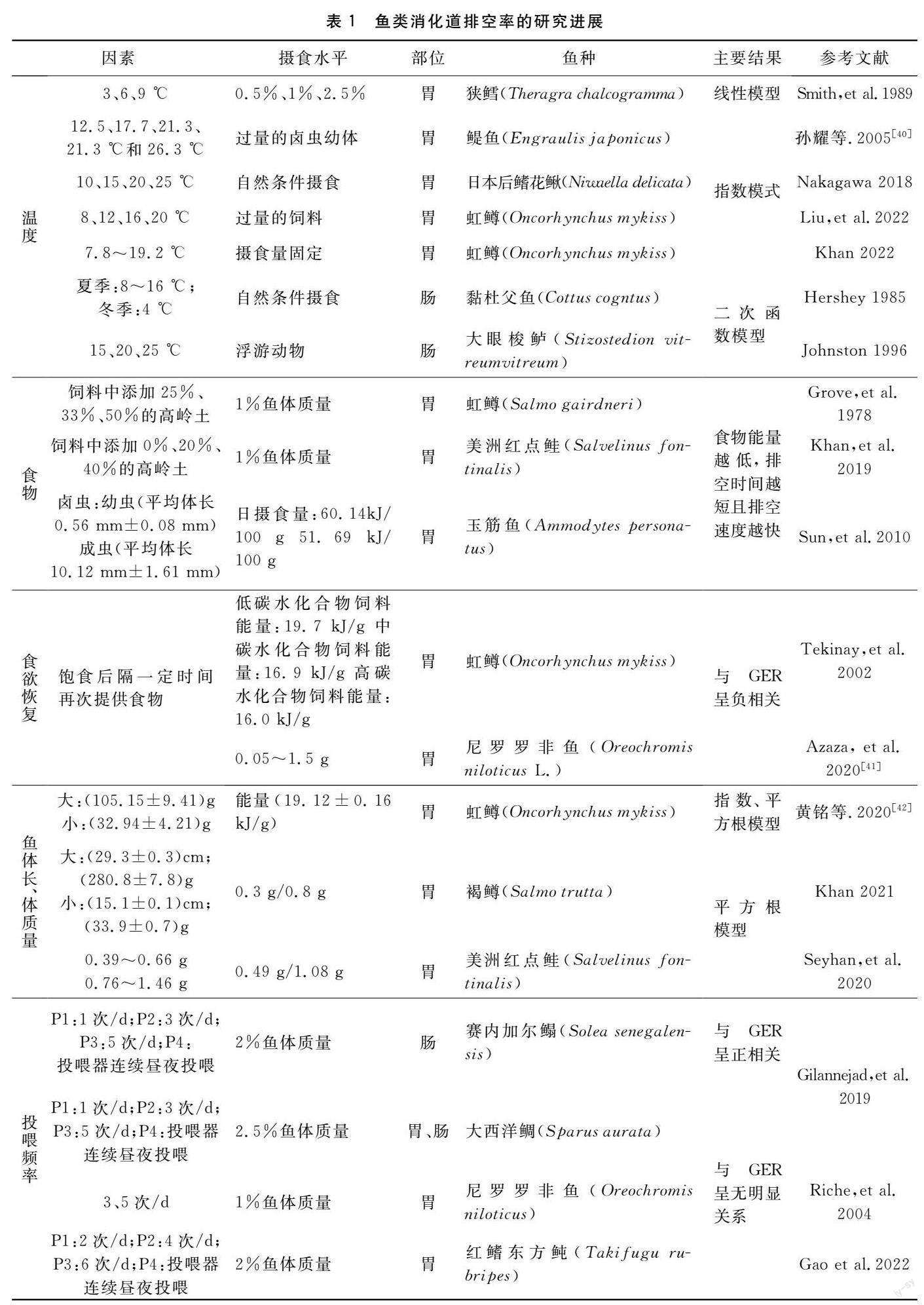
溫度是魚類生長和生存的最重要因素之一,顯著影響魚類的生理、生化功能,如攝食量和機體消化、吸收狀況[11]。排空率與溫度有一定的函數關系,對狹鱈( Theragra chalcogramm )在3 ℃、6 ℃、9 ℃的排空率研究中發現,3~9 ℃內GER與溫度呈線性關系[12](見表 1)。但更多的研究表明,GER與溫度的關系以指數的形式表示。例如,在四種溫度(10、15、20 ℃和25 ℃)條件下對日本后鰭花鰍( Niwaella delicata )排空率結果表明,T≥20 ℃ GER值較高,在T≤15 ℃條件下接近于0[13]。此外發現,虹鱒( Oncorhynchus mykiss )在8、12、16 ℃和20 ℃四種溫度下,隨著溫度上升或體長增加,GER呈現一個先上升再下降的趨勢[14](見表 1)。大量研究表明,GER會隨著溫度的上升先快速上升,持續上升至接近魚體耐受溫度時,GER逐漸平緩,超過極限溫度后急劇下降,但并不表現出有最佳溫度。然而,在7.8 ℃至19.2 ℃的水溫下,對虹鱒的排空率研究發現,其在18.5 ℃時達到最佳,隨后在21 ℃時急劇下降為0[15],此最佳溫度可能是魚體最適生長溫度。黏杜父魚( Cottus cogntus )和大眼梭鱸( Stizostedion vitreumvitreum )的結果均顯示排空率和溫度之間用二次方程表示關系更適合[16-17](見表 1)。為了更好地考察溫度與排空率之間的關系,在試驗溫度設計上應設置在該魚種生存的最適溫度前后幾個溫度值進行試驗,過低或過高的溫度并不適于魚體健康的生長發育。
1.2 食物
食物顆粒的大小及形狀是影響魚類排空率的主要因素,當食物顆粒較小且表面積大時,與胃酸和酶接觸就越充分,從而更易于消化和排出;同理,食物越細長,GER就越快[18]。對平均體質量(0.85±0.21)g的玉筋魚( Ammodytes personatus )投喂鹵蟲幼蟲(平均體長0.56 mm±0.08 mm)和成蟲(平均體長10.12 mm±1.61 mm)的胃排空率研究發現,攝食鹵蟲幼蟲的排空較快速,且攝食幼蟲的日攝食量的能量密度高于攝食成蟲(60.14>51.69 kJ/100 g),但其日增長率顯著低于攝食成蟲(14.86 kJ/100 g<19.50 kJ/100 g),說明攝食顆粒越小,通過增加食物的攝入量來彌補機體對能量的需求,但用于魚體生長所需的能量較少[19]。投喂魚體重1%的飼料(飼料中添加25%、33%、50%的高嶺土)對虹鱒( Salmo gairdneri )胃排空研究發現,添加50%高嶺土的飼料胃排空時間減少5 h[20]。同樣,對美洲紅點鮭投喂1%魚體重的飼料(添加0%、20%、40%的高嶺土)發現,食物能量越低,GER越快[5],說明魚類所攝食的餌料能量密度與排空率呈負相關關系[21-24](見表1)。
1.3 食欲恢復
食欲恢復率是指飽餐后某一時間自愿進食的量,可通過在一定胃排空時間后投喂過量的食物(滿足試驗動物最大攝食量),在魚不進行自主攝食后吸出殘餌,并計算攝食量的方法獲得。食欲恢復率已被用于估計有胃的魚[25]和無胃的魚(如大頭鳚 Blennius pholis )[26]的排空率。通過了解魚類攝食后消化水平和排空情況,可知曉其食欲恢復的狀況。由于魚類攝食量受胃飽和度影響,在胃內食糜向腸內運輸過程中,魚類再進食分兩種情況:一是等到胃幾乎排空才重新攝食(如俄勒岡葉唇魚 Ptychocheilus oregonensis );二是在胃部有空余就恢復食欲并開始進食。大部分魚屬于第二種,而其攝食量小于第一種[27]。因此,當食糜排出時間小于胃排空時間時,對魚類再次投喂食物其表現出食欲增加但攝食不多,與胃飽滿度有關;而當魚類的食欲恢復達到高峰,在此時進行投喂,其攝食量增加,生長率和飼料轉化率提高[28]。在對虹鱒進行三種不同碳水化合物飼料(低:19.7 kJ/g;中:16.9 kJ/g;高:16.0 kJ/g)的食欲恢復研究中發現,其與碳水化合物含量無顯著影響,但與GER呈負相關[29](見表 1)。
1.4 魚體長、體質量
魚的體長、體質量在是否作為排空的因素上一直存在爭議。學者們認為是由于魚體大小不同而導致在消化道結構上存在差異,且幼魚的排空模型不能用成魚的來解釋[30-31]。然而,研究不同體長(大:29.3 cm±0.3 cm;小:15.1 cm±0.1 cm)和體質量(大:280.8 g±7.8 g;小:33.9 g±0.7 g)的褐鱒( Salmo trutta ),并以0.3 g和0.8 g的飼料進行投喂時發現,平方根模型都能很好地描述GER[32]。Seyhan等[33]也發現平方根能很好地描述體質量(大:0.76~1.46 g;小:0.39~0.66 g)美洲紅點鮭( Salvelinus fontinalis )的GER(見表 1)。
1.5 投喂頻率
當低投喂頻率不能提供足夠的食物來維持魚的健康生長,會導致魚類營養不良;而高投喂頻率會使魚類攝入的食物通過消化道速度更快,造成飼料利用不充分,魚類對食物消化吸收率降低,且連續攝食的魚表現出更強的活動行為,這可能導致更高的能量消耗[34-35]。
研究發現,一些魚類的排空率與投喂頻率呈正相關關系。如歐洲黃蓋鰈( Limanda limanda )[36]的GER和賽內加爾鰨( Solea senegalensis )的腸排空率[37],而歐洲黃蓋鰈在6.5 ℃時這種關系消失。有些魚類的GER與投喂頻率關系不明顯,例如,以兩種投喂頻率(3次/d、5次/d)按1%魚體質量投喂尼羅羅非魚( Oreochromis niloticus )發現,瞬時疏散率差異不顯著[38]。對紅鰭東方鲀( Takifugu rubripes )以魚體質量2%的攝食量進行不同投喂頻率(P1:2次/d;P2:4次/d;P3:6次/d;P4:投喂器連續晝夜投喂)的研究發現,P1—P4對GER沒有影響,3 h內約有50%的餌料排出,且P2的增重率、特定生長率和飼料效率均最佳( P <0.05),該投喂間隔可獲得最佳的生長性能[39]。詳見表 1。
2 消化道排空率的研究方法及模型
2.1 消化道排空率的研究方法
排空研究方法分為野外研究和實驗室研究,野外試驗側重于對自然環境中動物的食性和食物鏈等方面的研究,而實驗室試驗側重于對配合飼料的開發與利用、促進對魚體生長率和提倡綠色工廠化養殖等方面的研究。目前,對于排空研究已經采用了許多不同的方法。
胃泵是通過用胃管對胃上增加壓力擠出其中的內容物。這種方法是對研究大型且數量有限魚類的攝食習性和攝食量需求時所出現的一種方法。通過此方法可以不需要處死試驗魚從而檢查其胃中的食糜[43]。通過對褐鱒的胃排空率研究中使用胃泵后立即處死一尾褐鱒來檢查其效率。結果發現,每組10尾魚中隨機被處死的一尾魚,胃中均無食糜。說明胃泵沒有對褐鱒產生不利的影響,其可恢復到正常的狀態[44]。
X-射線照相是一種在不殺死魚的情況下快速并可直接呈現消化道排空影像的技術[45]。常采用BaSO4作為指示劑,其是一種易于測定的、不引起魚類反感的指示劑。此方法研究了歐洲黃蓋鰈[46]、虹鱒[20]、巴西鯛( Prochilodus scrofa )[47]、馬拉巴笛鯛( Lutjanus malabaricus )[3,48-49]的腸道運動。學者們發現BaSO4與食物以相同的速度在消化道通過,且在轉運過程中不與食物分離,此方法適用于研究魚體內的食糜運輸和跟蹤觀察整個消化道運動對食糜的影響。指示劑法可通過不處死試驗魚,避免魚體發生應激所產生的消化能力降低的影響,還可研究處于攝食時試驗魚的消化道排空情況,但此法不適用于在自然條件下魚類攝食天然餌料的試驗。
在魚類食物添加放射活性的物質也是研究胃排空的一種方法。144Ce標記的飼料投喂菱體兔牙鯛( Lagodon rhomboides )來估計其排空的時間[50]。在對用131I和51Cr標記的飼料投喂虹鱒的研究中,發現131I比51Cr更利于跟蹤觀察,是很好的示蹤劑[51]。
連續宰殺的方法簡單、易操作,不需要復雜的設備,能較好觀察試驗魚消化道中的食糜變化量,但此方法需要處死大量試驗魚。在魚類試驗中受動物數量方面的限制影響較小,因此,對魚類的排空研究來說,往往采用連續宰殺的方法[2,57],例如,對澳大利亞鯛( Pagrus auratus )[29]、歐洲鱸( Dicentrarchus labrax )[52]、云龍石斑魚( E.moara ♀ × E.lanceolatus ♂ )[53]、厚頜魴( Megalobrama pellegrini )[54]、太平洋藍鰭金槍魚( Thunnus orientalis )[55]、條紋鋸鮨( Centropristis striata )[56]、黃條鰤[7]等排空研究采用了此方法。然而,此方法不足的是,試驗魚只有一次的操作機會,不可重復操作。因此,為了提高試驗數據的準確度,需要進行大規模的取樣測定。
2.2 消化道排空率的模型
將排空率這一原理結合在試驗中通過一定的間隔時間解剖試驗魚所獲得的消化道食糜的重量,以此評估魚類的每天的攝食量、食欲恢復的時間和對飼料的轉化利用率等指標[58]。往往此試驗方式所得到的結果更符合客觀事實。有關魚類排空率的試驗結論不斷出現,由于魚類的食性、消化道結構不同,同時受其攝食食物和某些神經系統的調控的影響,導致其排空方式具有多樣性,因此,不同種屬的魚類的最適數學模型必然不統一。己有報道中直線模型、指數模型、平方根模型、冪函數模型、邏輯斯蒂克模型、Gompertz模型以及倒數模型均有出現,其中以直線、指數、平方根模型最為常用[57]。模型如下所示:
直線模型:Y=A-Bt;
指數模型:Y=A×e-Bt;
平方根模型:Y0.5=A-B×t;
冪函數模型:Y=2-(t/A)B;
邏輯斯蒂克模型:Y=100-A/1+e-B(t+C);
Gompertz模型:Y=100-AeBe(Ct);
倒數模型:Y=A+B1/t0.1。
式中: Y 為胃/腸內殘余食物的重量、百分比或胃/腸飽滿度; t為攝食后的時間;A、B、C 為常數。
對這些擬合模型的評價參數有:除相關系數(R2)、殘差平方和(RSS)外,還有殘差的標準差(SDR)等。試驗研究過程中大多數通過群體喂養的方式進行,把攝食量大小的算術平均值計為每個魚體的攝食水準,未注意魚體之間的攝食強度有所不同,而造成試驗數據的誤差[59]。由于排空模型擬合的是平均值而不是觀察值,因此,只能用統計學方法來選擇最佳的排空模型。
3 展望
近年來,對魚類排空率的研究已有大量研究,但由于消化道排空模型擬合具有在特定條件下的局限性,受很多因素(水環境、食物、生理及魚類自身發育情況等)的影響,從而導致即使是同種魚類之間也可能因各種因素影響而產生不同模型擬合結果。因此,為使消化道排空率更具有參考性,應全面考慮影響排空率的因素。目前,尚未發現對不同發育階段的魚類進行消化道排空率的研究,從此方向研究可很好地評估出不同生長階段下集約化養殖的魚類所需適宜生長的攝食率、消化率及攝食頻率等重要參數。對于集約化養殖魚類而言,更應注重溫度、投喂食物能量及食欲恢復等排空因素,從而促進魚類健康生長發育和利于高效綠色、經濟化的工廠化養殖業的發展。
參考文獻:
[1] 李曉東,羅智,何東,等.食糜在矛尾復鰕虎魚消化道排空速度及其營養含量的變化[J].水產科學,2009,28(2):59-62.
[2] 余方平,許文軍,薛利建,等.美國紅魚的胃排空率[J].海洋漁業,2007,29(1):49-52.
[3] MAZUMDER S K,DE M,MAZLAN A G,et al.Impact of global climate change on fish growth,digestion and physiological status:developing a hypothesis for cause and effect relationships[J].Journal of Water and Climate Change,2015,6(2):200-226.
[4] 孫耀,劉勇,張波,等.渤、黃海 4 種小型魚類攝食排空率的研究[J].海洋與湖沼,2002,33(6):679-684.
[5] KHAN U,SEYHAN K.Gastric evacuation rates in farmed brook trout subjected to a range of feeding conditions fed commercial pellets[J].Aquaculture,2019,513:734390.
[6] 張鵬飛.綠鰭馬面鲀幼魚投喂策略及對不同原料營養物質表觀消化率[D].上海:上海海洋大學,2020.
[7] 李明月,高云紅,萬金銘,等.黃條鰤幼魚胃排空特征,消化酶活性及攝食調控基因表達[J].水產學報,2022,46(6):906-916.
[8] 謝敏,向建國,郭宵峰.鳡腸道排空速率的測定[J].科學養魚,2015(10):50-50.
[9] 李秀明,袁建明,曾令清,等.有氧運動訓練對中華倒刺鲃幼魚腸道排空及其數學模型選擇的影響[J].水生生物學報,2015,39(5):1012-1018.
[10] LE H T M D,SHAO X,KROGDAHL ?,et al.Intestinal function of the stomachless fish,ballan wrasse( Labrus bergylta )[J].Frontiers in Marine Science,2019,6:140.
[11] KOVACEVIC A,LATOMBE G,Chown S L.Rate dynamics of ectotherm responses to thermal stress[J].Proceedings of the royal society B,2019,286(1902):20190174.
[12] SMITH R L,PAUL J M,PAUL A J.Gastric evacuation in walleye pollock, Theragra chalcogramma [J].Canadian Journal of Fisheries and Aquatic Sciences,1989,46(3):489-493.
[13] NAKAAGAWA H.Temperature-dependent gastric evacuation rate of the Japanese delicate loach? Niwaella delicata( Cobitidae)[J].Ichthyological research,2018,65:172-174.
[14] LIU R,ZHOU Y,LI Z,et al.Evaluation of the effects of temperature on gastric evacuation and the associated mathematical models in different sizes steelhead trout( Oncorhynchus mykiss )[J].Aquaculture,2022,549:737815.
[15] KHAN.Temperature,meal size and body size effects on the gastric evacuation of rainbow trout:modelling optimum and upper thermal limits[J].Journal of Fish Biology,2022,100(6):1388-1398.
[16] HERSHEY A E,McDonald M E.Diet and digestion rates of slimy sculpin, Cottus cognatus, in an Alaskan arctic lake[J].Canadian Journal of Fisheries and Aquatic Sciences,1985,42(3):483-487.
[17] JOHNSTON T A,Mathias J A.Gut evacuation and absorption efficiency of walleye larvae[J].Journal of fish biology,1996,49(3):375-389.
[18] JOBLING M.Influences of food particle size and dietary energy content on patterns of gastric evacuation in fish:test of a physiological model of gastric emptying[J].Journal of Fish Biology,1987,30(3):299-314.
[19] SUN Y,LIU Y,LIU X,et al.The influence of particle size of dietary prey on food consumption and ecological conversion efficiency of young-of-the-year sand lance, Ammodytes personatus [J].Deep Sea Research Part II:Topical Studies in Oceanography,2010,57(11-12):1001-1005.
[20] GROVE D J,LOIZIDES L G,NOTT J.Satiation amount,frequency of feeding and gastric emptying rate in? Salmo gairdneri [J].Journal of Fish Biology,1978,12(5):507-516.
[21] ANDERSEN N G.A gastric evacuation model for three predatory gadoids and implications of using pooled field data of stomach contents to estimate food rations[J].Journal of Fish Biology,2001,59(5):1198-1217.
[22] TEMMING A,Herrmann J P.Gastric evacuation in horse mackerel.I.The effects of meal size,temperature and predator weight[J].Journal of Fish Biology,2001a,58(5):1230-1245.
[23] TEMMING A,Herrmann J P.Gastric evacuation of horse mackerel.II.The effects of different prey types on the evacuation model[J].Journal of Fish Biology,2001b,58(5):1246-1256.
[24] TEMMING A,Herrmann J P.Gastric evacuation in cod:prey-specific evacuation rates for use in North Sea,Baltic Sea and Barents Sea multi-species models[J].Fisheries Research,2003,63(1):21-41.
[25] KIRBOE T.Laboratory measurements of digestion rate in 0-group flounder( Platichthys flesus? L.) at two temperatures[J].Ophelia,1978,17(1):155-161.
[26] GROVE D J,Crawford C.Correlation between digestion rate and feeding frequency in the stomachless teleost, Blennius pholis L [J].Journal of Fish Biology,1980,16(3):235-247.
[27] 李冰冰,馮森.影響魚類攝食量的因素[J].漁業致富指南,2013(2):33-35.
[28] BOOTH M A,TUCKER B J,ALLAN G L,et al.Effect of feeding regime and fish size on weight gain,feed intake and gastric evacuation in juvenile Australian snapper? Pagrus auratus [J].Aquaculture,2008,282(1-4):104-110.
[29] TEKNAY A A,DAVIES S J.Effects of dietary carbohydrate level on gastric evacuation and return of appetite in the rainbow trout, Oncorhynchus mykiss [J].Turkish Journal of Biology,2002,26(1):25-31.
[30] LAMBERT T C.Gastric emptying time and assimilation efficiency in Atlantic mackerel( Scomber scombrus )[J].Canadian journal of zoology,1985,63(4):817-820.
[31] MILLS E L,READY R C,JAHNCKE M,et al.A gastric evacuation model for young yellow perch, Perca flavescens [J].Canadian Journal of Fisheries and Aquatic Sciences,1984,41(3):513-518.
[32] KHAN U,SEYHAN K.Parameterizing an expanded square root model to account for the effects of temperature,meal size,and body size on gastric evacuation rate in farmed brown trout[J].Aquaculture Research,2021,52(10):4849-4857.
[33] SEYHAN K,BASCINAR N S,BASCINAR N,et al.Gastric evacuation in brook trout( Salvelinus fontinalis ) fry:Effect of body size[J].Pakistan Journal of Zoology,2020,52(3):1173.
[34] DWYER K S,BROWN J A,PARRISH C,et al.Feeding frequency affects food consumption,feeding pattern and growth of juvenile yellowtail flounder( Limanda ferruginea )[J].Aquaculture,2002,213(1-4):279-292.
[35] TIAN J,HE G,MAI K,et al.Effects of postprandial starvation on mRNA expression of endocrine-,amino acid and peptide transporter-,and metabolic enzyme-related genes in zebrafish( Danio rerio )[J].Fish physiology and biochemistry,2015,41:773-787.
[36] GWYTHER D,GROVE D J.Gastric emptying in? Limanda limanda (L.) and the return of appetite[J].Journal of Fish Biology,1981,18(3):245-259.
[37] GILANNEJAD N,SILVA T,MARTNEZ-RODRGUEZ G,et al.Effect of feeding time and frequency on gut transit and feed digestibility in two fish species with different feeding behaviours,gilthead seabream and Senegalese sole[J].Aquaculture,2019,513:734438.
[38] RICHE M,HALEY D I,OETKER M,et al.Effect of feeding frequency on gastric evacuation and the return of appetite in tilapia? Oreochromis niloticus(L.) [J].Aquaculture,2004,234(1-4):657-673.
[39] GAO X Q,WANG X,WANG X Y,et al.Effects of different feeding frequencies on the growth,plasma biochemical parameters,stress status,and gastric evacuation of juvenile tiger puffer fish( Takifugu rubripes )[J].Aquaculture,2022,548:737718.
[40] 孫耀,劉勇,于淼,等.東、黃海鳀魚的胃排空率及其溫度影響[J].生態學報,2005(2):215-219.
[41] AZAZA M S,DHRAIEF M N.Modeling the effects of water temperature on growth rates,gastric evacuation and the return of appetite in juvenile Nile tilapia, Oreochromis niloticus L [J].Journal of Agricultural Science,2020,12(8):191-201.
[42] 黃銘,周演根,楊小剛,等.兩種規格虹鱒胃排空模型和投喂頻率的研究[J].中國海洋大學學報(自然科學版),2020,50(12):33-39.
[43] STRANGE C D,KENNEDY G J A.Stomach flushing of salmonids:a simple and effective technique for the removal of the stomach contents[J].Aquaculture Research,1981,12(1):9-15.
[44] ELLIOTT J M.Rates of gastric evacuation in brown trout, Salmo trutta L [J].Freshwater Biology,1972,2(1):1-18.
[45] MOLNR G,TLG I.Roentgenologic investigation of duration of gastric digestion of pike-perch, Lucioperca lucioperca [J].Acta Biol.Hung,1960,(11):103-108.
[46] JOBLING M,GWYTHER D,GROVE D J.Some effects of temperature,meal size and body weight on gastric evacuation time in the dab? Limanda limanda(L) [J].Journal of Fish Biology,1977,10(3):291-298.
[47] BARBIERI R L,LEITE R G,STERMAN F A,et al.Food passage time through the alimentary tract of a brazilian teleost fish, Prochilodus scrofa (Steindachner,1881) using radiography[J].Brazilian Journal of Veterinary Research and Animal Science,1998,35:32-36.
[48] MAZUMDER S K,DAS S K,BAKAR Y,et al.Effects of temperature and diet on length-weight relationship and condition factor of the juvenile Malabar blood snapper( Lutjanus malabaricus? Bloch & Schneider,1801)[J].Journal of Zhejiang University.Science.B,2016,17(8):580.
[49] MAZUMDER S K,ABD GHAFFAR M,DAS S K.Effect of temperature and diet on gastrointestinal evacuation of juvenile malabar blood snapper( Lutjanus malabaricus? Bloch & Schneider,1801)[J].Aquaculture,2020,522:735114.
[50] PETERS D S,HOSS D E.A radioisotopic method of measuring food evacuation time in fish[J].Transactions of the American Fisheries Society,1974,103(3):626-629.
[51] STOREBAKKEN T,AUSTRENG E,STEENBERG K.A method for determination of feed intake in salmonids using radioactive isotopes[J].Aquaculture,1981,24:133-142.
[52] ADAMIDOU S,NENGAS I,ALEXIS M,et al.Apparent nutrient digestibility and gastrointestinal evacuation time in European seabass( Dicentrarchus labrax ) fed diets containing different levels of legumes[J].Aquaculture,2009,289(1-2):106-112.
[53] 高云紅,景琦琦,黃濱,等.云龍石斑魚胃排空特征和攝食消化特性研究[J].漁業科學進展,2020,41:1-9.
[54] 曲煥韜,廖建新,代偉,等.厚頜魴幼魚的胃排空特征及其數學模型研究[J].水產科學,2021,40(4):583-588.
[55] MURSHITA K,HASHIMOTO H,TAKASHI T,et al.Characterization of digestive physiology in Pacific bluefin tuna? Thunnus orientalis? juveniles fed a raw fish feed and a commercial diet[J].Aquaculture,2021,538:736562.
[56] 彭志蘭,李凌剛,鄭圓圓,等.條紋鋸鮨胃排空特征和適宜投喂頻率研究[J].海洋漁業,2021,43(3):318-326.
[57] 張波,郭學武,孫耀,等.溫度對真鯛排空率的影響[J].海洋科學,2001,25(9):14-15.
[58] 曾令清,李鳳杰,曹振東,等.南方鲇幼魚的胃排空特征及其數學模型[J].水產學報,2011,35(2):231-237.
[59] 李可貴,曹振東,付世建.鲇魚幼魚的胃排空率及其模型分析[J].重慶師范大學學報(自然科學版),2009,(3):14-17.
Abstract:The factors affecting the evacuation rate of fish digestive tract(temperature, food, appetite recovery, fish length, body weight and feed frequency), the experimental methods(gastric pump, X-ray photography, addition of radioactive substances to food, and continuous slaughtering) and the research emptying models(linear model, exponential model, square root model, power function model, logistic method, Gompertz model and reciprocal model) were reviewed from researches in recent years.
Key words:digestive tract evacuation;fish;influencing factors;test method
(收稿日期:2023-03-20)
猜你喜歡
現代經濟信息(2016年19期)2016-10-20 18:46:44
現代經濟信息(2016年19期)2016-10-20 18:12:28
現代經濟信息(2016年19期)2016-10-20 16:20:30
中國科技博覽(2016年19期)2016-10-19 13:33:22
中國科技博覽(2016年18期)2016-10-19 10:49:54
中國科技博覽(2016年18期)2016-10-19 08:16:45
中國科技博覽(2016年18期)2016-10-19 06:39:44
中國市場(2016年36期)2016-10-19 03:54:01
中國市場(2016年35期)2016-10-19 02:30:10
商(2016年27期)2016-10-17 07:09:07