認知診斷評估中Q矩陣理論及應用
2024-06-08 21:43:46宋麗紅汪文義丁樹良
心理科學進展 2024年6期
宋麗紅 汪文義 丁樹良
摘 ?要 ?Q矩陣是認知心理學與心理計量學結合的重要載體, Q矩陣在認知診斷中發揮著十分重要的作用。Q矩陣理論和應用研究近年來取得了重要進展。眾多研究者從結構化到非結構化、屬性二值到多值、簡單到復雜模型、獨立到一般結構、0-1到多級評分方面不斷深入和拓展Q矩陣理論。Q矩陣理論也廣泛應用于測驗構念效度評價、計算機化自適應測驗選題策略設計、Q矩陣學習和標定、認知診斷測驗組卷等。與模型無關的Q矩陣理論和適合特定認知診斷模型下Q矩陣理論, 以及最新Q矩陣理論的應用都值得深入研究。
關鍵詞 ?認知診斷, Q矩陣, 屬性結構, 完備性, 多值屬性
分類號 ?B841
1 ?引言
認知診斷評價是心理計量學與認知心理學結合的產物。認知診斷評價廣泛應用于教育評價(educational assessment)、精神評估(psychiatric evaluation)、疾病病因檢測(disease etiology detection)等領域(Gu & Xu, 2020, 2023; Xu, 2017)。研究顯示(王立君 等, 2020; Toprak, 2021; von Davier & Lee, 2019), 認知診斷在學習系統中學習者弱項診斷、報告反饋與資源推薦, 在大規模評價數據分析與細粒度診斷, 在識別問題解決策略和職業教育, 在教學干預方法或個性化補救教學效果評價等方面都發揮著重要作用。Tatsuoka (1983, 1995, 2009)率先提出了Q矩陣, 記為 , 其元素 表示被試正確作答項目 需要掌握屬性 , ?表示項目 不考查屬性 。Q矩陣用于表示問題解決過程中所需要的潛在認知屬性(技能、知識), 它也被視為統計模式識別所需提取的特征(Tatsuoka, 2009)。Q矩陣是認知模型的形式化表示, 代表需要檢驗的測驗結構假設, 是結構效度的直接證據(Rupp et al., 2010)。
Tatsuoka (2009)提出Q矩陣理論, 所解決的核心問題是建立觀察反應模式與潛在知識狀態之間的數學聯系。只有建立兩者間的聯系, 認知診斷評價才能根據被試在測驗上觀察作答反應模式推斷知識狀態。聯系建立主要有以下兩種方式。第一種方式, 在連接(conjunctive)或非連接(disjunctive)認知假設下, 通過計算理想反應模式作為橋梁建立兩者的聯系, 包括規則空間模型的布爾描述函數(Boolean description function; Tatsuoka, 1991, 2009), 屬性層級方法(attribute hierarchy method, AHM))的期望(理想)反應模式(Leighton et al., 2004), 確定性輸入噪音與門(deterministic inputs, noisy and gate, DINA; Haertel, 1989)和確定性輸入噪音或門(deterministic inputs, noisy or gate, DINO; Templin & Henson, 2006)模型的潛在反應模式, 非參數化聚類或分類方法中理想反應模式(康春花 等, 2017, 2023; 李元白 等, 2018; 汪文義, 丁樹良 等, 2015; Chiu et al., 2008, 2009; Chiu & Douglas, 2013; Chiu & Chang, 2021), 以及知識空間理論的問題函數(problem function, Heller et al., 2015, 2017; Heller, 2022)。第二種方式, 通過一般化認知診斷模型建立知識狀態、項目特征與項目反應之間的統計模型, 如拓廣的DINA (the generalized DINA, G-DINA; de la Torre, 2011)模型、對數線性認知診斷模型(the log-linear cognitive diagnosis model, LCDM; Henson et al., 2009)和概括化模型(the general diagnostic model, GDM; von Davier, 2008)等。
Tatsuoka (2009)認為, 在屬性獨立時, 如果測驗Q矩陣是 階單位矩陣或者包含所有 非零屬性向量, 通過布爾描述函數計算理想反應模式, 可建立 個知識狀態與 個理想反應模式一一對應關系。Chiu等人(2009)提出包含單位矩陣的完備Q矩陣概念, 并用于認知診斷屬性子分數向量聚類分析。與此同時, 在屬性層級結構下, 丁樹良等人(2009)提出包含可達矩陣的充要Q矩陣概念。Chiu等人、丁樹良等人自此以后一直深入研究Q矩陣理論, 比如結構化Q矩陣(the structured Q-matrix)和非結構化Q矩陣(the unstructured Q-matrix)的條件及其相關問題(丁樹良 等, 2022; Chiu & Chang, 2021)。Q矩陣中所有屬性向量均符合屬性層級結構, 稱為結構化Q矩陣, 否則稱為非結構化Q矩陣。知識空間理論研究團隊也一直研究完備Q矩陣(Heller, 2022)。除了關注二值Q矩陣外, 因為學生在同一屬性的水平往往呈現不同認知水平, 許多研究關注多值Q矩陣理論(蔡艷, 涂冬波, 2015; 丁樹良, 羅芬 等, 2015; 丁樹良, 汪文義 等, 2015; 詹沛達 等, 2016)或多值Q矩陣下的認知診斷模型與方法(Chen & de la Torre, 2013; de la Torre et al., 2022; Karelitz, 2004; Ma, 2022; Sun et al., 2013; Zhan et al., 2020, 2023)。
Q矩陣設計是認知診斷測驗設計中十分重要的方面(丁樹良 等, 2011, 2019; Liu et al., 2016; Madison & Bradshaw, 2015; Tian et al., 2020; Tu et al., 2019)。設計測驗各個題目所測量的屬性, 即解決Q矩陣設計或測驗藍圖問題, 是認知診斷的核心任務(Leighton et al., 2004)。Tatsuoka (2009)提出充分Q矩陣用于指導認知診斷測驗編制。完備Q矩陣作為一種重要Q矩陣設計, 對于提高分類準確率具有重要作用。DeCarlo (2011)在分析分數減法數據時發現, 不完備Q矩陣會引起嚴重的分類問題, 測驗Q矩陣設計不當, 測驗為被試在某些屬性上帶來的信息甚至還不如先驗信息。丁樹良等人(2011)研究發現, 完備Q矩陣(至少含一個可達矩陣)比不完備Q矩陣的模式判準率高出20%以上。Tian等人(2020)發現完備Q矩陣可提高縱向診斷分類模型的分類準確率。Madison和Bradshaw (2015)比較了不同Q矩陣設計對分類準確率的影響, 相比其他不完備Q矩陣, 包含每個屬性單獨測量1次或2次的Q矩陣(完備Q矩陣)在參數估計算法收斂性、屬性分類準確率和屬性信度方面均具有明顯優勢。Kuo等人(2016)例子顯示, 在線性屬性層級結構下, 基于認知診斷指標或屬性診斷指標選擇試題, 所得測驗Q矩陣不完備, 由此提出了具有更高判準率的組卷方法。
Q矩陣設計還與認知診斷模型識別問題和參數估計量的一致性密切相關。統計模型可識別, 是得到參數一致估計和有效推斷結果的必要條件, 也是獲得可靠且有效結果的基礎(Gu & Xu, 2019b)。Q矩陣不完備會引起知識狀態等價類, 即造成同一等價類中多個知識狀態的概率參數不可識別, 還會導致Q矩陣估計不可識別。認知診斷模型識別問題早有關注(DeCarlo, 2011; DiBello et al., 1995; Liu et al., 2013; Maris, 1999; Xu, 2013; Xu, & Zhang, 2016)。在DINA模型下, Liu等人(2013)率先考慮了猜測參數已知時Q矩陣可識別的條件。Chen等人(2015)、Xu和Shang (2018)考慮了項目參數已知時Q矩陣可識別的充分條件, 即Q矩陣中需要包含兩個單位矩陣等條件。Xu等人自2013年至今一直專注于認知診斷模型參數識別性問題研究。
Q矩陣在結構表征、測驗設計、模型識別、診斷分類等方面具有重要作用, 并且諸多研究者長期深入研究Q矩陣理論并取得了大量成果, 但目前缺乏相關的文獻綜述與評論。本文重點梳理近15年Q矩陣理論和應用, 主要涉及理想反應、非參數方法、知識空間理論、模型識別框架下完備Q矩陣, 及其在測驗構念效度評價、計算機化自適應測驗選題策略設計、Q矩陣學習和標定、認知診斷測驗組卷等方面的應用, 最后討論與模型無關和新模型下Q矩陣理論和應用研究的未來方向。
2 ?Q矩陣理論
2.1 ?理想反應下完備Q矩陣
2.1.1 ?充分Q矩陣
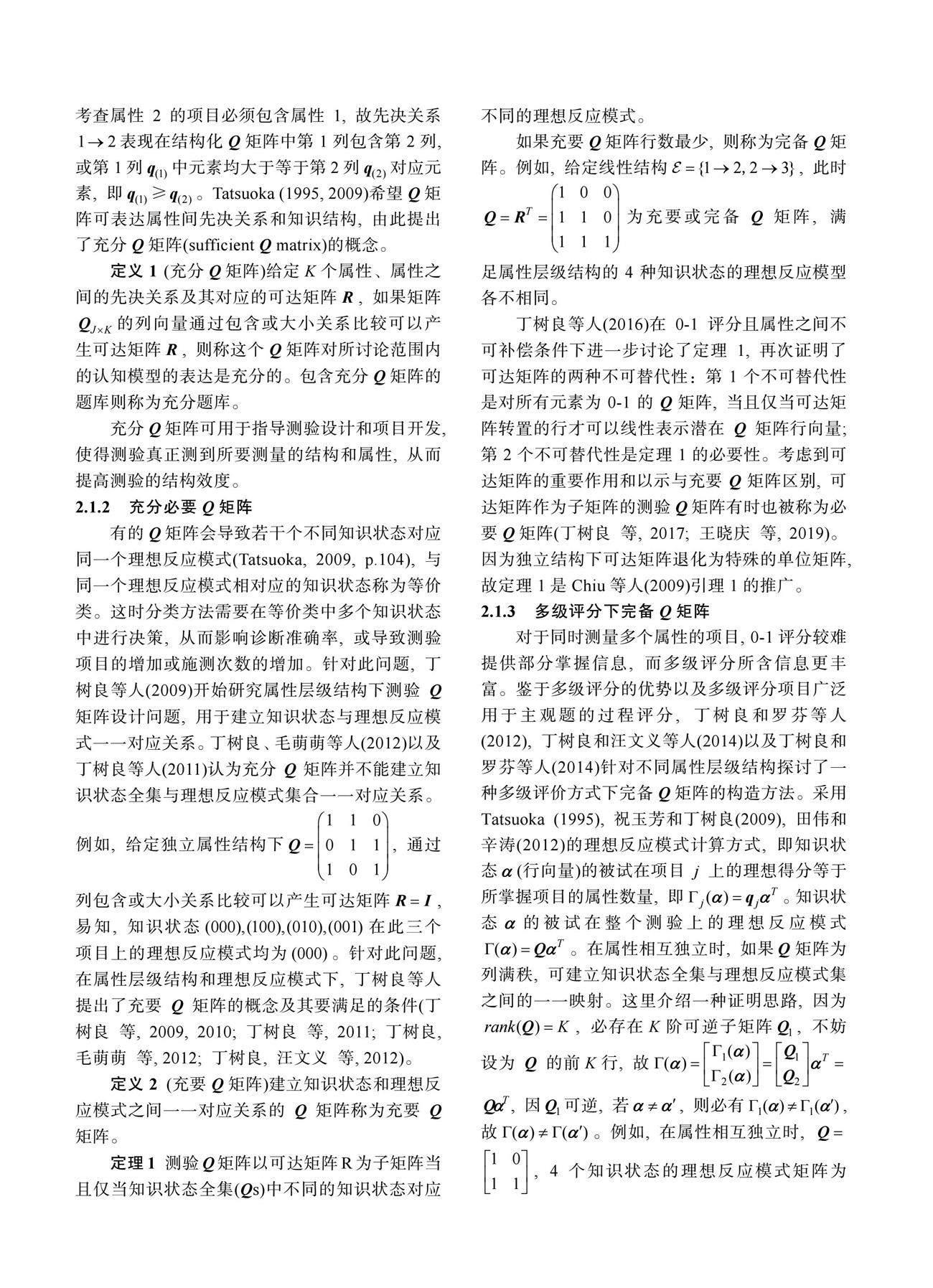
在屬性間存在先決關系時, 如 表示要掌握屬性2必先掌握1, 如果采用結構化Q矩陣, 考查屬性2的項目必須包含屬性1, 故先決關系 表現在結構化Q矩陣中第1列包含第2列, 或第1列 中元素均大于等于第2列 對應元素, 即 。Tatsuoka (1995, 2009)希望Q矩陣可表達屬性間先決關系和知識結構, 由此提出了充分Q矩陣(sufficient Q matrix)的概念。
定義1 (充分Q矩陣)給定 個屬性、屬性之間的先決關系及其對應的可達矩陣 , 如果矩陣 的列向量通過包含或大小關系比較可以產生可達矩陣 , 則稱這個Q矩陣對所討論范圍內的認知模型的表達是充分的。包含充分Q矩陣的題庫則稱為充分題庫。
充分Q矩陣可用于指導測驗設計和項目開發, 使得測驗真正測到所要測量的結構和屬性, 從而提高測驗的結構效度。
4 ?討論
在梳理了認知診斷研究領域近15年來Q矩陣理論研究結果基礎之上, 重點介紹了完備Q矩陣核心內容和結合例子解釋相關理論結果, 并簡要敘述了Q矩陣理論的代表性應用研究結果。Q矩陣理論研究趨勢如圖1所示。完備Q矩陣研究發展過程, 透視出完備Q矩陣呈現從獨立和屬性層級結構到一般結構, 從簡化的DINA和DINO模型到一般化認知診斷模型, 從二值Q矩陣到多值Q矩陣, 從二值評分到多級評分, 從理想反應模式到期望反應模式等方面不斷深入的規律性。
Q矩陣理論的發展也基本引領了認知診斷各方面應用:(1)根據屬性層級結構, 預先設計基于理想反應模式的完備Q矩陣, 可用于指導測驗題目編制; (2)評價測驗Q矩陣與屬性層級結構一致性的理論構念效度指標, 可用于測驗實施之前Q矩陣設計質量評價; (3)在收集數據之后, 可結合數據驅動的Q矩陣標定方法學習測驗Q矩陣, 可
輔助學科專家確定測驗所考查的屬性數和驗證已有Q矩陣。在確定部分項目的Q矩陣之后, 尤其是可達矩陣的測驗項目, 可以添加未標定Q矩陣
的新題進入測驗, 再收集數據后, 采用半監督式Q矩陣標定方法得出新題的Q矩陣; (4)在構建了包含Q矩陣和項目參數的題庫基礎之上, 如果采用計算機化自適應診斷測驗, 可以針對采用的認知診斷模型選擇相應的初始題選題方法和后續選題方法, 實施自適應測驗; (5)在構建了包含Q矩陣和項目參數的題庫基礎之上, 可以使用計算機自動組卷, 用于線性測驗或多階段測驗。
表2詳細地列出了Q矩陣特點、滿足條件、應用情景和推薦的診斷方法。根據認知機制的分類(von Davier & Lee, 2019), 因為連接或非補償(conjunctive or non-compensatory)、非連接或補償(disjunctive or compensatory)經常互用, 故表2中僅分為連接和非連接。已有文獻尚未對所有組合條件進行研究, 比如Gu和Xu (2021a, 2023)尚未研究屬性層級結構下一般化認知診斷模型可識別的條件, 以及Heller (2022)僅給出一般結構下連接機制的結論, 故表中并沒有窮盡所有組合條件。在表2中, 小樣本條件下均推薦NPC, 這主要有三方面考慮:第一, 因為伴隨列出的測驗Q
圖1 ?Q矩陣理論研究趨勢
表2 ?完備Q矩陣應用條件
結構 水平 機制 Q矩陣 理論基礎 樣本量 診斷方法
層級 二值 連接 Q矩陣包含單位矩陣
Q矩陣可達矩陣R (定理1)
Q矩陣包含介于兩者之間的E* (定理4) Chiu (2009)
丁樹良等(2010)
K?hn和Chiu (2019, 2021)
Heller (2022) 小 NPC
定理10或定理11的條件 Gu和Xu (2021a, 2023) 中 DINA-AHM
非連接 Q矩陣包含單位矩陣(充分條件) Chiu和K?hn (2015b) 小 NPC
定理A6 Gu和Xu (2021a, 2023) 中 DINO-AHM
原文中定理3(充分條件) Gu和Xu (2021a, 2023) 中 ACDM/LLTM
獨立 二值 連接 Q矩陣包含單位矩陣
定理2或定理3的條件 Chiu (2009)
Heller (2022) 小 NPC
定理8的條件 Gu和Xu (2019b) 中 DINA
非連接 Q矩陣包含單位矩陣 Chiu和K?hn (2015b) 小 NPC
定理8的條件 Gu和Xu (2019b) 中 DINO
定理9的條件 Gu和Xu (2020, 2021b) 中 ACDM/LLTM
大 GDINA
LCDM
GDM
層級
(含獨立) 多值 非連接 Q矩陣包含擬可達矩陣 丁樹良, 羅芬等(2015)
Sun等人(2013)
蔡艷和涂冬波(2015) 中 GDD-P
一般 二值 連接 Q矩陣包含基本屬性模式矩陣B或定理5、6、7中條件 Heller (2022) 小 NPC
注:小樣本量 = 0-500; 中樣本量 = 500-1000; 大樣本量 = 1000以上; NPC = 非參數方法; GDD-P = 多級屬性的廣義距離判別法; ACDM = 加性認知診斷模型; LLTM = 線性邏輯斯蒂克模型。
矩陣要求較低(僅要求包含單位矩陣或可達矩陣), 這尚不能滿足DINA或DINO模型參數嚴格或部分可識別的條件; 第二, 樣本量500基本上是認知診斷模型獲得較高精度時對樣本量的最低要求, 這是眾多研究形成的共識(參見:Sen & Cohen, 2021)。雖然融入先驗分布信息的貝葉斯估計方法可以加速算法收斂, 但是樣本量500比樣本量30或100的模式判準率至少高20%或10% (Ma & Jiang, 2021); 第三, 根據最新研究(Ma, de la Torre, & Xu, 2023), NPC和拓廣NPC (the general NPC, GPNC)仍是小樣本量下推薦方法。
不同定義下的完備Q矩陣, 分別可用于測驗不同階段并發揮不同作用, 以及伴隨著推薦的認知診斷模型或方法。基于理想反應模式的完備Q矩陣首先可用于指導測驗設計, 在給定屬性及其層級關系以后, 可以根據屬性層級結構設計完備Q矩陣, 并用于指導測驗題目編制。在收集到實測數據之后, 在小樣本量情景下, 可采用非參數認知診斷方法(NPC或GNPC); 在樣本量中等情景下, 可采用DINA、DINO、加性認知診斷模型(the additive cognitive diagnosis model, ACDM)或線性邏輯斯蒂克模型(linear logistic test model, LLTM); 在大樣本量情景下, 可以選用一般化認知診斷模型(GDINA、LCDM、GDM), 借助模型可識別條件并結合數據分析, 判斷Q矩陣、項目參數、分布參數、屬性結構等參數的可識別性。
5 ?展望
與模型無關Q矩陣理論和一般化認知診斷模型下Q矩陣理論值得深入研究。因為基于理想反應模式所定義的完備Q矩陣可應用于測驗設計, 這對于指導認知診斷測驗開發至關重要, 開展部分識別下與模型無關Q矩陣理論研究對于不同粒度診斷具有重要意義。已有研究主要給出了DINA、DINO模型下 , ?, ?等可識別的充要條件, 但是對于一般化認知診斷模型主要給出的是充分條件(Culpepper, 2023; Gu & Xu, 2019b, 2021a, 2021b, 2023), 并且相關結論已經用于從數據中學習屬性層級結構和Q矩陣(Ma, Ouyang, & Xu, 2023; Xiong et al., 2022)。一般化認知診斷模型 , ?, ?可識別是否存在充要條件, 充要條件是什么, 有的充分條件、嚴格(一般)可識別及推導過程仍然比較復雜(Culpepper, 2023; He et al., 2023), 能否變化成更為簡潔的條件, 這些問題仍值得研究。較多研究關注如何從數據中學習屬性結構(Chen & Wang, 2023; Ma, Ouyang, & Xu, 2023; Wang & Lu, 2021)。模型部分識別和一般性識別理論, 對于屬性層級結構下Q矩陣、結構、屬性數、參數學習有何借鑒意義, 有待探討。多值Q矩陣下非結構化完備Q矩陣的相應問題也值得探究(丁樹良 等, 2022)。
最新認知診斷模型和新開發模型下Q矩陣理論及應用也值得拓展。多策略(Ma & Guo, 2019; Wang et al., 2023)、多級評分(Chen & de la Torre, 2018; He et al., 2023; Liu & Jiang, 2018; Ma & de la Torre, 2016)、混合評分(Liu et al., 2022)、屬性多級(Bao, 2019; Ma & Jiang, 2021)等模型下, Q矩陣理論仍值得研究。例如, 已有研究在二值Q矩陣下, 采用每掌握一屬性計一分的多級評分方式, 得出了完備Q矩陣須滿足列滿秩條件(丁樹良, 羅芬 等, 2014; 丁樹良, 汪文義 等, 2014)。還有研究在多值Q矩陣下, 采用當被試屬性掌握水平等于或高于項目所考查屬性水平并以考查水平記分的多級評分方式, 得出了完備Q矩陣須含擬可達矩陣的充分條件(Sun et al., 2013)。這兩種評分方式有一定的應用場景。對于分小題(類別)評分且小題(類別)可能考查一個、多個屬性時, 如果給定各分數類別的屬性向量, 也稱為約束類別Q矩陣(a restricted QC-matrix), 在使用約束序貫多級評分模型(the restricted sequential G-DINA model)時(Ma & de la Torre, 2016), 約束類別Q矩陣如何設計也值得討論。在新開發認知診斷模型時, 也要注意Q矩陣設計, 以保證新模型各類參數可識別。
有待深入開展Q矩陣理論在屬性標定、選題策略、組卷方法中的應用研究。Q矩陣理論中完備Q矩陣, 特別是非結構化完備Q矩陣的研究, 除指導認知診斷測驗設計之外, 對于Q矩陣學習標定或驗證、選題策略、題庫建設、多步驟自適應測驗等方面也有著潛在應用價值(丁樹良 等, 2022)。Q矩陣估計或修正方法取得了一定的發展(李佳 等, 2021), 但是屬性層級、多級屬性、多策略下Q矩陣估計和修正尚待研究。在屬性層級結構下Q矩陣估計和驗證方法中, 少標屬性、多標屬性對Q矩陣估計和驗證方法的影響或修正, 都值得進一步研究。一般化認知診斷模型下完備Q矩陣, 如何用于計算機化自適應診斷測驗序貫優化Q矩陣設計與選題策略設計, 怎樣改進屬性層級結構下組卷方法(唐小娟 等, 2013, 2022), 仍有待考慮。
參考文獻
蔡艷, 涂冬波. (2015). 屬性多級化的認知診斷模型拓展及其Q矩陣設計. 心理學報, 47(10), 1300?1308.
昌維, 詹沛達, 王立君. (2018). 認知診斷中多分屬性與二分屬性的對比研究. 心理科學, 41(4), 982?988.
丁樹良, 羅芬, 汪文義. (2012). Q矩陣理論的擴展. 心理學探新, 32(5), 417?422.
丁樹良, 羅芬, 汪文義. (2014). 多級評分認知診斷測驗藍圖的設計——獨立型和收斂型結構. 江西師范大學學報(自然科學版), 38(3), 265?269.
丁樹良, 羅芬, 汪文義, 李佳, 熊建華. (2022). 非結構化完備Q陣的構造與判定. 江西師范大學學報(自然科學版), 46(5), 441?446.
丁樹良, 羅芬, 汪文義, 熊建華. (2015). 0-1和多值可達矩陣的性質及應用. 江西師范大學學報(自然科學版), 39(1), 64?68.
丁樹良, 羅芬, 汪文義, 熊建華. (2019). 0-1評分認知診斷測驗設計. 江西師范大學學報(自然科學版), 43(5), 441?447.
丁樹良, 毛萌萌, 汪文義, 羅芬, Cui, Y. (2012). 教育認知診斷測驗與認知模型一致性的評估. 心理學報, 44(11), 1535?1546.
丁樹良, 汪文義, 羅芬. (2012). 認知診斷中Q矩陣和Q矩陣理論. 江西師范大學學報(自然科學版), 36(5), 441?445.
丁樹良, 汪文義, 羅芬. (2014). 多級評分認知診斷測驗藍圖的設計——根樹型結構. 江西師范大學學報(自然科學版), 38(2), 111?118.
丁樹良, 汪文義, 羅芬, 熊建華. (2015). 多值Q矩陣理論. 江西師范大學學報(自然科學版), 39(4), 365?370.
丁樹良, 汪文義, 羅芬, 熊建華. (2016). 可達陣功能的不可替代性. 江西師范大學學報(自然科學版), 40(3), 290?294+298.
丁樹良, 汪文義, 羅芬, 熊建華. (2017). Q矩陣理論探微. 江西師范大學學報(哲學社會科學版), 50(1), 71?79.
丁樹良, 汪文義, 羅芬, 熊建華. (2018). Q矩陣標定的一種簡便方法. 江西師范大學學報(自然科學版), 42(2), 130?133.
丁樹良, 汪文義, 楊淑群. (2011). 認知診斷測驗藍圖的設計. 心理科學, 34(2), 258?265.
丁樹良, 楊淑群, 汪文義. (2010). 可達矩陣在認知診斷測驗編制中的重要作用. 江西師范大學學報(自然科學版), 34(5), 490?494.
丁樹良, 祝玉芳, 林海菁, 蔡艷. (2009). Tatsuoka Q矩陣理論的修正. 心理學報, 41(2), 175-181.
高椿雷, 羅照盛, 鄭蟬金, 喻曉鋒, 彭亞風, 郭小軍. (2017). CD-CAT初始階段項目選取方法. 心理科學, 40(2), 485?491.
康春花, 楊亞坤, 曾平飛. (2017). 海明距離判別法分類準確率的影響因素. 江西師范大學學報(自然科學版), 41(4), 394?400.
康春花, 朱仕浩, 宮皓明, 曾平飛. (2023). 一種可融入額外信息的機器學習診斷法. 心理科學, 46(1), 212?220.
李佳, 毛秀珍, 張雪琴. (2021). 認知診斷Q矩陣估計(修正)方法. 心理科學進展, 29(12), 2272?2280.
李元白, 曾平飛, 楊亞坤, 康春花. (2018). 一種非參數的多策略方法:多策略的海明距離判別法. 江西師范大學學報(自然科學版), 42(1), 67?73.
羅芬, 王曉慶, 丁樹良, 熊建華. (2018). 自適應分組認知診斷測驗設計及其選題策略. 心理科學, 41(3), 720?726.
唐小娟, 丁樹良, 毛萌萌, 俞宗火. (2013). 基于屬性層級結構的認知診斷測驗的組卷. 心理學探新, 33(3), 252?259.
唐小娟, 丁樹良, 俞宗火. (2022). 題目屬性向量平衡策略的認知診斷測驗設計. 心理科學, 45(6), 1466?1474.
田偉, 辛濤. (2012). 基于等級反應模型的規則空間方法. 心理學報, 44(1), 249?262.
涂冬波, 蔡艷, 戴海琦. (2013). 認知診斷CAT選題策略及初始題選取方法. 心理科學, 36(2), 469?474.
王立君, 唐芳, 詹沛達. (2020). 基于認知診斷測評的個性化補救教學效果分析: 以“一元一次方程”為例. 心理科學, 43(6), 1490?1497.
汪文義, 丁樹良, 宋麗紅. (2015). 認知診斷中基于條件期望的距離判別方法. 心理學報, 47(12), 1499?1510.
汪文義, 宋麗紅, 丁樹良. (2015). 基于探索性因素分析的Q矩陣標定方法. 江西師范大學學報(自然科學版), 39(2), 138?144+170.
汪文義, 宋麗紅, 丁樹良. (2018). 基于可達陣的一種Q矩陣標定方法. 心理科學, 41(4), 968?975.
王曉慶, 丁樹良, 羅芬. (2019). 認知診斷中的Q矩陣及其作用. 心理科學, 42(3), 739-746.
詹沛達, 邊玉芳, 王立君. (2016). 重參數化的多分屬性診斷分類模型及其判準率影響因素. 心理學報, 48(3), 318?330.
詹沛達, 丁樹良, 王立君. (2017). 多分屬性層級結構下引入邏輯約束的理想掌握模式. 江西師范大學學報(自然科學版), 41(3), 289?295.
祝玉芳, 丁樹良. (2009). 基于等級反應模型的屬性層級方法. 心理學報, 41(3), 267?275.
Bao, Y. (2019). A diagnostic classification model for polytomous attributes (Unpublished doctoral dissertation). University of Georgia.
Briggs, D., Alonzo, A., Schwab, C., & Wilson, M. (2006). Diagnostic assessment with ordered multiple-choice items. Educational Assessment, 11(1), 33?63.
Briggs, D. C., & Alonzo, A. C. (2012). The psychometric modeling of ordered multiple-choice item responses for diagnostic assessment with a learning progression. In A.C. Alonzo, & A.W. Gotwals (Eds.), Learning progressions in science (pp. 293?316). Rotterdam, Sense Publishers.
Cai, Y., Tu, D., & Ding, S. (2018). Theorems and methods of a complete Q matrix with attribute hierarchies under restricted Q-matrix design. Frontiers in Psychology, 9, Article 1413.
Chang, Y. P., Chiu, C. Y., & Tsai, R. C. (2019). Nonparametric CAT for CD in educational settings with small samples. Applied Psychological Measurement, 43(7), 543?561.
Chen, J., & de la Torre, J. (2013). A general cognitive diagnosis model for expert-defined polytomous attributes. Applied Psychological Measurement, 37(6), 419?437.
Chen, J., & de la Torre, J. (2018). Introducing the general polytomous diagnosis modeling framework. Frontiers in Psychology, 9, Article 1474.
Chen, Y., Liu, J., Xu, G., & Ying, Z. (2015). Statistical analysis of Q-matrix based diagnostic classification models. Journal of the American Statistical Association, 110(510), 850?866.
Chen, Y., & Wang, S. (2023). Bayesian estimation of attribute hierarchy for cognitive diagnosis models. Journal of Educational and Behavioral Statistics, 48(6), 810?841. https://doi.org/10.3102/10769986231174918.
Chiu, C.-Y., & Chang, Y. (2021). Advances in CD-CAT: The general nonparametric item selection method. Psychometrika, 86(4), 1039?1057.
Chiu, C.-Y, & Douglas, J. (2013). A nonparametric approach to cognitive diagnosis by proximity to ideal response patterns. Journal of Classification, 30, 225?250.
Chiu, C.-Y., Douglas, J. A., & Li, X. D. (2008). Cluster analysis for cognitive diagnosis: Theory and applications (Unpublished doctoral dissertation). University of Illinois at Urbana-Champaign.
Chiu, C.-Y., Douglas, J. A., & Li, X. (2009). Cluster analysis for cognitive diagnosis: Theory and applications. Psychometrika, 74(4), 633?665.
Chiu, C.-Y., & K?hn, H.-F. (2015a). A general proof of consistency of heuristic classification for cognitive diagnosis models. British Journal of Mathematical and Statistical Psychology, 68(3), 387?409.
Chiu, C.-Y., & K?hn, H.-F. (2015b). Consistency of cluster analysis for cognitive diagnosis: The DINO model and the DINA model revisited. Applied Psychological Measurement, 39(6), 465?479.
Culpepper, S. A. (2023). A note on weaker conditions for identifying restricted latent class models for binary responses. Psychometrika, 88(1), 158?174.
Decarlo, L. T. (2011). On the analysis of fraction subtraction data: The DINA model, classification, latent class sizes, and the Q-matrix. Applied Psychological Measurement, 35(1), 8?26.
Dibello, L. V., Stout, W. F., & Roussos, L. A. (1995). Unified cognitive psychometric diagnostic assessment likelihood-based classification techniques. In P. D. Nichols, S. F. Chipman, & R. L. Brennan (Eds.), Cognitively Diagnostic Assessment (pp. 361?389). Routledge.
de la Torre, J. (2011). The generalized DINA model framework. Psychometrika, 76(2), 179?199.
de la Torre, J., Qiu, X. L., & Santos, K.C. (2022). An empirical Q-matrix validation method for the polytomous G-DINA model. Psychometrika, 87(2), 693?724.
Falmagne, J.-C., & Doignon, J.-P. (2011). Learning spaces: Interdisciplinary applied mathematics. Berlin, Heidelberg: Springer.
Gu, Y., & Xu, G. (2019a). Learning attribute patterns in high-dimensional structured latent attribute models. Journal of Machine Learning Research, 20(115), 1?58.
Gu, Y., & Xu, G. (2019b). The sufficient and necessary condition for the identifiability and estimability of the DINA model. Psychometrika, 84(2), 468?483.
Gu, Y., & Xu, G. (2020). Partial identifiability of restricted latent class models. The Annals of Statistics, 48(4), 2082?2107.
Gu, Y., & Xu, G. (2021a). Identifiability of hierarchical latent attribute models. Retrieved July 15, 2023, from https://arxiv.org/abs/1906.07869.
Gu, Y., & Xu, G. (2021b). Sufficient and necessary conditions for the identifiability of the Q-matrix. Statistica Sinica, 31(1), 449?472.
Gu, Y., & Xu, G. (2023). Identifiability of hierarchical latent attribute models. Statistica Sinica, 33, 1?31.
Haertel, E. H. (1989). Using restricted latent class models to map the skill structure of achievement items. Journal of Educational Measurement, 26(4), 301?321.
He, S., Culpepper, S. A., Douglas, J. (2023). A sparse latent class model for polytomous attributes in cognitive diagnostic assessments. In L.A. van der Ark, W.H.M. Emons, & R.R. Meijer (Eds.), Essays on Contemporary Psychometrics (pp. 413?442). Springer.
Heller, J. (2022). Complete Q-matrices in conjunctive models on general attribute structures. British Journal of Mathematical and Statistical Psychology, 75(2), 522?549.
Heller, J., Anselmi, P., Stefanutti, L., & Robusto, E. (2017). A necessary and sufficient condition for unique skill assessment. Journal of Mathematical Psychology, 79, 23?28.
Heller, J., Stefanutti, L., Anselmi, P., & Robusto, E. (2015). On the link between cognitive diagnostic models and knowledge space theory. Psychometrika, 80(4), 995?1019.Henson, R. A., Templin, J. L., & Willse, J. T. (2009). Defining a family of cognitive diagnosis models using log-linear models with latent variables. Psychometrika, 74(2), 191?210.
Kaplan, M., de la Torre, J., & Barrada, J. R. (2015). New item selection methods for cognitive diagnosis computerized adaptive testing. Applied Psychological Measurement, 39(3), 167?188.
Karelitz, T. M. (2004). Ordered category attribute coding framework for cognitive assessments (Unpublished doctoral dissertation). University of Illinois at Urbana- Champaign.
K?hn, H.-F., & Chiu, C.-Y. (2017). A procedure for assessing the completeness of the Q-matrices of cognitively diagnostic tests. Psychometrika, 82(1), 112?132.
K?hn, H.-F., Chiu, C. -Y. (2018). How to build a complete Q-matrix for a cognitively diagnostic test. Journal of Classification, 35, 273?299.
K?hn, H.-F., & Chiu, C.-Y. (2019). Attribute hierarchy models in cognitive diagnosis: Identifiability of the latent attribute space and conditions for completeness of the Q-matrix. Journal of Classification, 36, 541?565.
K?hn, H.-F., & Chiu, C.-Y. (2021). A unified theory of the completeness of Q-matrices for the DINA model. Journal of Classification, 38(3), 500?518.
Kuo, B.-C., Pai, H.-S., & de la Torre, J. (2016). Modified cognitive diagnostic index and modified attribute-level discrimination index for test construction. Applied Psychological Measurement, 40(5), 315?330.
Leighton, J., & Gierl, M. (2007). Cognitive diagnostic assessment for education: Theory and applications. Cambridge, UK: Cambridge University Press.
Leighton, J. P., Gierl, M. J., & Hunka, S. M. (2004). The attribute hierarchy method for cognitive assessment: A variation on Tatsuokas rule-space approach. Journal of Educational Measurement, 41(3), 205?237.
Liu, J., Xu, G., & Ying, Z. (2012). Data-driven learning of Q-matrix. Applied Psychological Measurement, 36(7), 548?564.
Liu, J., Xu, G., & Ying, Z. (2013). Theory of self-learning Q-matrix. Bernoulli, 19(5A), 1790?1817.
Liu, R. (2018). Misspecification of attribute structure in diagnostic measurement. Educational and Psychological Measurement, 78(4), 605?634.
Liu, R., Huggins-Manley, A. C., & Bradshaw, L. (2016). The impact of Q-matrix designs on diagnostic classification accuracy in the presence of attribute hierarchies. Educational and Psychological Measurement, 77(2), 220?240.
Liu, R., & Jiang, Z. (2018). Diagnostic classification models for ordinal item responses. Frontiers in Psychology, 9, Article 2512, https://doi.org/10.3389/fpsyg.2018.02512.
Liu, R., Liu, H., Shi, D., & Jiang, Z. (2022). Diagnostic classification models for a mixture of ordered and non-ordered response options in rating scales. Applied Psychological Measurement, 46(7), 622?639.
Liu, Y., Xu, G., & Ying, Z. (2011). Learning item-attribute relationship in Q-matrix based diagnostic classification models. Retrieved July 15, 2023, from http://arxiv.org/ pdf/1106.0721v1.pdf.
Ma, C., Ouyang, J. & Xu, G. (2023). Learning latent and hierarchical structures in cognitive diagnosis models. Psychometrika, 88(1), 175?207.
Ma, W. (2022). A higher-order cognitive diagnosis model with ordinal attributes for dichotomous response data. Multivariate Behavioral Research, 57(2-3), 408?421.
Ma, C., de la Torre, J. & Xu, G. (2023). Bridging parametric and nonparametric methods in cognitive diagnosis. Psychometrika, 88(1), 51?75.
Ma, W., & de la Torre, J. (2016). A sequential cognitive diagnosis model for polytomous responses. British Journal of Mathematical and Statistical Psychology, 69(3), 253?275.
Ma, W., & Guo, W. (2019). Cognitive diagnosis models for multiple strategies. British Journal of Mathematical and Statistical Psychology, 72(2), 370?392.
Ma, W., & Jiang, Z. (2021). Estimating cognitive diagnosis models in small samples: Bayes modal estimation and monotonic constraints. Applied Psychological Measurement, 45(2), 95?111.
Madison, M. J., & Bradshaw, L. P. (2015). The effects of q-matrix design on classification accuracy in the log-linear cognitive diagnosis model. Educational and Psychological Measurement, 75(3), 491?511.
Maris, E. (1999). Estimating multiple classification latent class models. Psychometrika, 64(2), 187?212.
Rupp, A. A., Templin, J., & Henson, R. (2010). Diagnostic measurement: Theory, methods, and applications. New York, NY: Guilford Press.
Sen, S., & Cohen, A. S. (2021). Sample size requirements for applying diagnostic classification models. Frontiers in Psychology, 11, Article 621251. https://doi.org/10.3389/ fpsyg.2020.621251.
Sun, J., Xin, T., Zhang, S., & de la Torre, J. (2013). A polytomous extension of the generalized distance discriminating method. Applied Psychological Measurement, 37(7), 503?521.
Sun, Y., Ye, S., Inoue, S., & Sun, Y. (2014). Alternating recursive method for Q-matrix learning. In J. C. Stamper, Z.A. Pardos, M. Mavrikis, & B. M. McLaren (Eds.), Proceedings of the 7th International Conference on Educational Data Mining (pp. 14?20). London, UK.
Sun, Y., Ye, S., Sun, Y., & Kameda, T. (2015). Improved algorithms for exact and approximate Boolean matrix decomposition. In Proceedings of the 2015 IEEE International Conference on Data Science and Advanced Analytics (pp.1?10). Paris, France.
Tang, X., Duan, H., Ding, S., & Mao, M. (2021). A simplified method for predicting pattern match ratio. Frontiers in Psychology, 12, Article 704724. https://doi.org/10.3389/fpsyg.2021.704724.
Tatsuoka, K. K. (1983). Rule-space: An approach for dealing with misconceptions based on item response theory. Journal of Educational Measurement, 20(4), 345?354.
Tatsuoka, K. K. (1991). Boolean algebra applied to determination of the universal set of knowledge states (ONR- Tech. Rep. No. RR-91-44). Princeton, NJ: Educational Testing Services.
Tatsuoka, K. K. (1995). Architecture of knowledge structures and cognitive diagnosis: A statistical pattern recognition and classification approach. In P. D. Nichols, S. F. Chipman, & R. L. Brennan (Eds.), Cognitively diagnostic assessment (pp. 327?361). Erlbaum.
Tatsuoka, K. K. (2009). Cognitive assessment: An introduction to the rule space method. New York: Routledge Taylor & Francis group.
Templin, J. L., & Henson, R. A. (2006). Measurement of psychological disorders using cognitive diagnosis models. Psychological Methods, 11(3), 287?305.
Tian, W., Zhang, J., Peng, Q., & Yang, X. (2020). Q-matrix designs of longitudinal diagnostic classification models with hierarchical attributes for formative assessment. Frontiers in Psychology, 11, Article 1694. https://doi.org/10.3389/fpsyg.2020.01694.
Toprak, T. E. (2021). An international comparison using cognitive diagnostic assessment: Fourth graders diagnostic profile of reading skills on PIRLS 2016. Studies In Educational Evaluation, 70(6), 101057. https://doi.org/ 10.1016/j.stueduc.2021.101057.
Tu, D., Wang, S., Cai, Y., Douglas, J., & Chang, H.-H. (2019). Cognitive diagnostic models with attribute hierarchies: Model estimation with a restricted Q-matrix design. Applied Psychological Measurement, 43(4), 255?271.
von Davier, M. (2008). A general diagnostic model applied to language testing data. British Journal of Mathematical and Statistical Psychology, 61(2), 287?307.
von Davier, M., & Lee, Y-S. (2019). Handbook of diagnostic classification models: Models and model extensions, applications, software packages. Springer.
Wang, C., & Lu, J. (2021). Learning attribute hierarchies from data: Two exploratory approaches. Journal of Educational and Behavioral Statistics, 46(1), 58?84.
Wang, D., Ma, W., Cai, Y., & Tu, D. (2023). A general nonparametric classification method for multiple strategies in cognitive diagnostic assessment. Behavior Research Methods, 56, 723?735. https://doi.org/10.3758/ s13428-023-02075-8.
Wang, W., Zheng, J., Song, L., Tu, Y., & Gao, P. (2021). Test assembly for cognitive diagnosis using mixed-integer linear programming. Frontiers in Psychology, 12, Article 623077. https://doi.org/10.3389/fpsyg.2021.623077.
Xiong, J., Luo, Z., Luo, G., & Yu, X. (2022). Data-driven Q-matrix learning based on Boolean matrix factorization in cognitive diagnostic assessment. British Journal of Mathematical and Statistical Psychology, 75(3), 638?667.
Xu, G. (2013). Statistical inference for diagnostic classification models (Unpublished doctoral dissertation). Columbia University, New York.
Xu, G. (2017). Identifiability of restricted latent class models with binary responses. The Annals of Statistics, 45(2), 675?707.
Xu, G., & Shang, Z. (2018). Identifying latent structures in restricted latent class models. Journal of the American Statistical Association, 113(523), 1284?1295.
Xu, G., Wang, C., & Shang, Z. (2016). On initial item selection in cognitive diagnostic computerized adaptive testing. The British Journal of Mathematical and Statistical Psychology, 69(3), 291?315.
Xu, G., & Zhang, S. (2016). Identifiability of diagnostic classification models. Psychometrika, 81(3), 625?649.
Zhan, P., Liu, Y., Yu, Z., & Pan, Y. (2023). Tracking ordinal development of skills with a longitudinal DINA model with polytomous attributes. Applied Measurement in Education, 36(2), 99?114.
Zhan, P., Wang, W. C., & Li, X. (2020). A partial mastery, higher-order latent structural model for polytomous attributes in cognitive diagnostic assessments. Journal of Classification, 37, 328?351.
Zheng, Y., & Chang, H. H. (2015). On-the-fly assembled multistage adaptive testing. Applied Psychological Measurement, 39(2), 104?118.
Q-matrix theory and its applications in cognitive diagnostic assessment
SONG Lihong1, WANG Wenyi2, DING Shuliang2
(1 School of Education, Jiangxi Normal University, Nanchang 330022, China)
(2 School of Computer and Information Engineering, Jiangxi Normal University, Nanchang 330022, China)
Abstract: The Q-matrix helps bridge the gap between cognitive psychology and psychometrics, and thus it plays a very important role in cognitive diagnostic assessment. Significant progress has been made in the Q-matrix theory and its applications in recent years. Numerous researchers have made significant contributions to the Q-matrix theory from structured to unstructured matrices, binary to polytomous attributes, simple to complex models, independent to general structures, and dichotomous to polytomous item responses. Following the introduction of the Q-matrix theory, four examples were presented to illustrate its applications in the theoretical validity criterion of diagnostic tests, the design of item selection methods in computerized adaptive test, the methods for Q-matrix learning and specification, and test construction for cognitive diagnosis. Model-free or model-based Q-matrix theory, and the applications of the latest Q-matrix theory needs to be further investigated.
Keywords: cognitive diagnosis, Q-matrix, attribute structure, complete, polytomous attributes