健身氣功對神經根型頸椎病的輔助治療作用研究
2020-03-23 09:35:35陳昌樂糜娟張雪亮王立夫鄭會麗胡敏李楠
上海醫藥
2020年4期
關鍵詞:神經根型頸椎病
陳昌樂 糜娟 張雪亮 王立夫 鄭會麗 胡敏 李楠

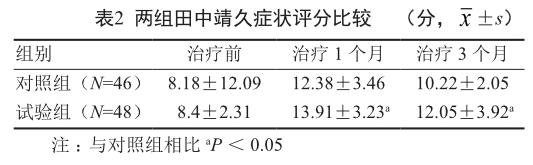
摘 要 目的:探討健身氣功對神經根型頸椎病的輔助治療作用。方法:收集2014年6月至2015年3月就診的神經根型頸椎病患者94例,隨機分為試驗組48例和對照組46例,兩組均采用相同的針灸治療1個月,試驗組同時加練健身氣功,每周至少5 d。于治療前、治療1個月和3個月后,用田中靖久癥狀量表評估功能,用視覺模擬測定(VAS)及現有疼痛強度(PPI)評估疼痛。結果:試驗組總有效率為93.75%(45/48),顯著高于對照組的86.96%(40/46,P<0.05),治療1個月后,試驗組田中靖久癥狀評分顯著高于對照組(P<0.05),VAS評分顯著低于對照組(P<0.05)。3個月后,試驗組田中靖久癥狀評分顯著高于對照組(P<0.05),VAS評分和PPI評分均顯著低于對照組(P<0.05)。結論:健身氣功對神經根型頸椎病有輔助治療作用。
關鍵詞 神經根型頸椎病;氣功;健身
中圖分類號:R687.3 文獻標志碼:A 文章編號:1006-1533(2020)04-0008-03
Study of the auxiliary therapeutic effect of health qigong on cervical spondylotic radiculopathy
CHEN Changle1, MI Juan1, Ida Ayu Anom Rastiti2, ZHANG Xueliang2, WANG Lifu2, ZHENG Huili2, HU Min3, LI Nan4(1. Shanghai Qigong Research Institute, Shanghai 200030; 2. Shanghai University of Traditional Chinese Medicine, Shanghai 201203; 3. Shimenerlu Community Health Service Center of Jingan District, Shanghai 200041, China; 4. Department of Gynecology of Hospital affiliated to University of Traditional Chinese Medicine of Shanxi, Xianyang 7120000, Shanxi Province, China)
ABSTRACT Objective: To explore the auxiliary therapeutic effect of health qigong on cervical spondylotic radiculopathy. Methods: Ninety-four patients with cervical spondylotic radiculopathy who were treated from June 2014 to March 2015 were collected and randomly divided into an experimental group with 48 cases and a control group with 46 cases, both groups were treated with the same acupuncture for one month, and at the same time, the experimental group practiced qigong at least 5 days a week. Before treatment, after 1 month and 3 months of treatment, the function was assessed with Tanaka Yasuhisa symptom scale, and visual analogue scale(VAS) and present pain intensity(PPI) were used to assess pain. Results: The total effective rate was 93.75%(45/48) in the experimental group, which was significantly higher than that 86.96%(40/46) in the control group(P<0.05). After 1 month of treatment, Tanaka Yasuku symptom score in the experimental group was significantly higher than that in the control group(P<0.05), and the VAS score in the experimental group was significantly lower than that in the control group(P<0.05). After 3 months, Tanaka Yasuku symptom score in the experimental group was significantly higher than that in the control group(P<0.05), and the VAS score and PPI score in the experimental group were significantly lower than those in the control group(P<0.05). Conclusion: Health qigong has the adjuvant therapeutic effect on cervical spondylotic radiculopathy
KEY WORDS cervical spondylotic radiculopathy; qigong; health
頸椎病是臨床常見病,隨著電腦、手機的普及,人們低頭工作時間不斷延長,致使頸椎病發病率逐年攀升,且年輕化趨勢日趨明顯。神經根型頸椎病在頸椎病中發病率最高,約占60%。臨床上對于頸椎病的治療方法很多,如牽引、針灸、推拿、刮痧、藥物、手術等,雖然都有一定療效,但也存在一些不足,如無法根治、價格昂貴、療效緩慢、復發率高、藥物反應大,手術存在風險和并發癥等問題。本文報道健身氣功對神經根型頸椎病的輔助治療作用。
1 資料與方法
1.1 一般資料
選取上海市楊浦區五角場社區衛生服務中心、上海市氣功研究所門診部2014年6月至2015年3月就診的神經根型頸椎病患者94例,均符合《實用骨科學(第4版)》[1]中的診斷標準,且影像學(CT、核磁共振)所見與臨床表現相符合。采用抽簽法將患者隨機分為試驗組48例和對照組46例。對照組中男21例,女25例,年齡(40.5±8.6)歲,病程(6.1±2.9)年;試驗組中男22例,女26例,年齡(38.7±8.4)歲,病程(6.9±3.1)年。……
登錄APP查看全文
猜你喜歡
云南中醫中藥雜志(2016年11期)2016-12-26 08:20:51
上海醫藥(2016年22期)2016-12-13 11:39:39
中國實用醫藥(2016年28期)2016-12-07 21:45:59
中外醫學研究(2016年26期)2016-11-30 04:27:54
中國民族民間醫藥·上半月(2016年10期)2016-11-19 10:41:38
中國實用醫藥(2016年19期)2016-08-05 23:09:20
中國實用醫藥(2016年9期)2016-05-17 11:14:42
養生保健指南(2016年4期)2016-03-22 12:09:44
上海醫藥(2016年2期)2016-03-07 23:40:07
中國實用醫藥(2016年2期)2016-01-05 19:58:21