醫(yī)院消毒供應室護理質(zhì)量控制在預防院內(nèi)感染中的作用觀察
2020-06-12 11:36:03馬曉晨
中國衛(wèi)生產(chǎn)業(yè)
2020年6期
關鍵詞:質(zhì)量控制
馬曉晨
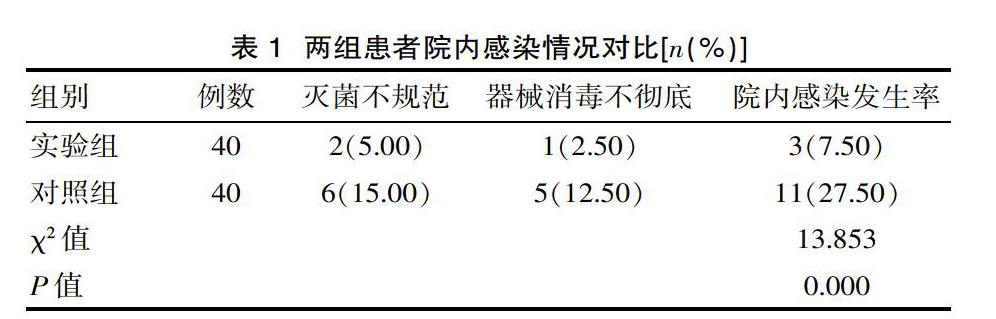
[摘要] 目的 探究醫(yī)院消毒供應室護理質(zhì)量控制在預防院內(nèi)感染中的作用。方法 選擇該院2018年1—6月消毒供應室未進行質(zhì)量控制的患者為對照組,另選擇該院2018年7—12月消毒供應室進行質(zhì)量控制的患者為實驗組,各40例,對比兩組患者院內(nèi)感染發(fā)生率及對護理人員的滿意度。結(jié)果 實驗組院內(nèi)感染發(fā)生率明顯低于對照組(P<0.05);實驗組對護理人員護理工作滿意度較對照組高(P<0.05)。結(jié)論 在醫(yī)院消毒供應室實施質(zhì)量控制能明顯降低院內(nèi)感染的發(fā)生率,提高患者對護理工作的滿意度。
[關鍵詞] 消毒供應室;護理質(zhì)量;質(zhì)量控制;院內(nèi)感染
[中圖分類號] R47 [文獻標識碼] A [文章編號] 1672-5654(2020)02(c)-0006-03
[Abstract] Objective To explore the role of nursing quality control in hospital disinfection supply room in preventing nosocomial infections. Methods Patients in the hospital from January to June 2018 who did not undergo quality control in the disinfection supply room were selected as control group, and patients in the hospital from July to December 2018 who were undergoing quality control were selected as experimental group, each with 40 cases, compared the incidence of nosocomial infection and satisfaction with the nursing staff in the two groups. Results The incidence of nosocomial infections in the experimental group was significantly lower than that in the control group(P<0.05); the experimental group had higher satisfaction with nursing staff than the control group(P<0.05). Conclusion Implementing quality control in the hospital disinfection supply room can significantly reduce the incidence of nosocomial infections and improve patient satisfaction with nursing work. It is worthy of further research and promotion.
[Key words] Disinfection supply room; Quality of care; Quality control; Nosocomial infection
消毒供應室是醫(yī)院為臨床各部門提供消毒器械的科室,通過臨床間接服務患者,承擔著醫(yī)院全部無菌物品的供應,其消毒質(zhì)量與醫(yī)院整體的護理質(zhì)量及患者生命安全密切相關[1]。為保障消毒效果,預防和減少院內(nèi)感染的發(fā)生,供應室護理人員需要具備較強的技術水平和責任意識,從而保障臨床工作的順利進行和患者的生命安全,因此加強消毒供應室質(zhì)量控制意義重大[2]。該次研究于2018年1—12月對該院收治的實施供應室護理質(zhì)量控制前后的80例患者進行分組對比,旨在探究醫(yī)院消毒供應室護理質(zhì)量控制在預防院內(nèi)感染中的效果,現(xiàn)報道如下。
1? 資料與方法
1.1? 一般資料
選擇該院2018年1—6月消毒供應室未進行質(zhì)量控制的40例患者為對照組,其中男26例、女14例;年齡45~65歲,平均(55.34±7.50)歲。對照組中的供應室護理人員15名,均為女性;年齡22~35歲,平均(26.47±1.33)歲;工作時間1~9年,平均(6.25±0.88)年。另選擇該院2018年7—12月消毒供應室進行質(zhì)量控制的40例患者為實驗組,其中男22例、女18例;年齡42~60歲,平均(50.22±6.89)歲。……
登錄APP查看全文
猜你喜歡
中國科技博覽(2016年19期)2016-10-19 13:36:59
中國科技博覽(2016年18期)2016-10-19 11:06:33
中國科技博覽(2016年18期)2016-10-19 09:03:36
中國科技博覽(2016年18期)2016-10-19 08:46:18
科技視界(2016年21期)2016-10-17 17:58:28
中國實用醫(yī)藥(2016年24期)2016-10-17 06:28:30
科學與財富(2016年28期)2016-10-14 19:44:52
科學與財富(2016年28期)2016-10-14 18:58:41
科學與財富(2016年28期)2016-10-14 18:44:58
科技視界(2016年20期)2016-09-29 13:11:33