兒童醫(yī)院神經(jīng)內(nèi)科帶教中存在的問(wèn)題及應(yīng)對(duì)策略分析
2020-06-22 13:04:45李秋玉
中國(guó)衛(wèi)生產(chǎn)業(yè)
2020年5期
關(guān)鍵詞:教學(xué)管理
李秋玉
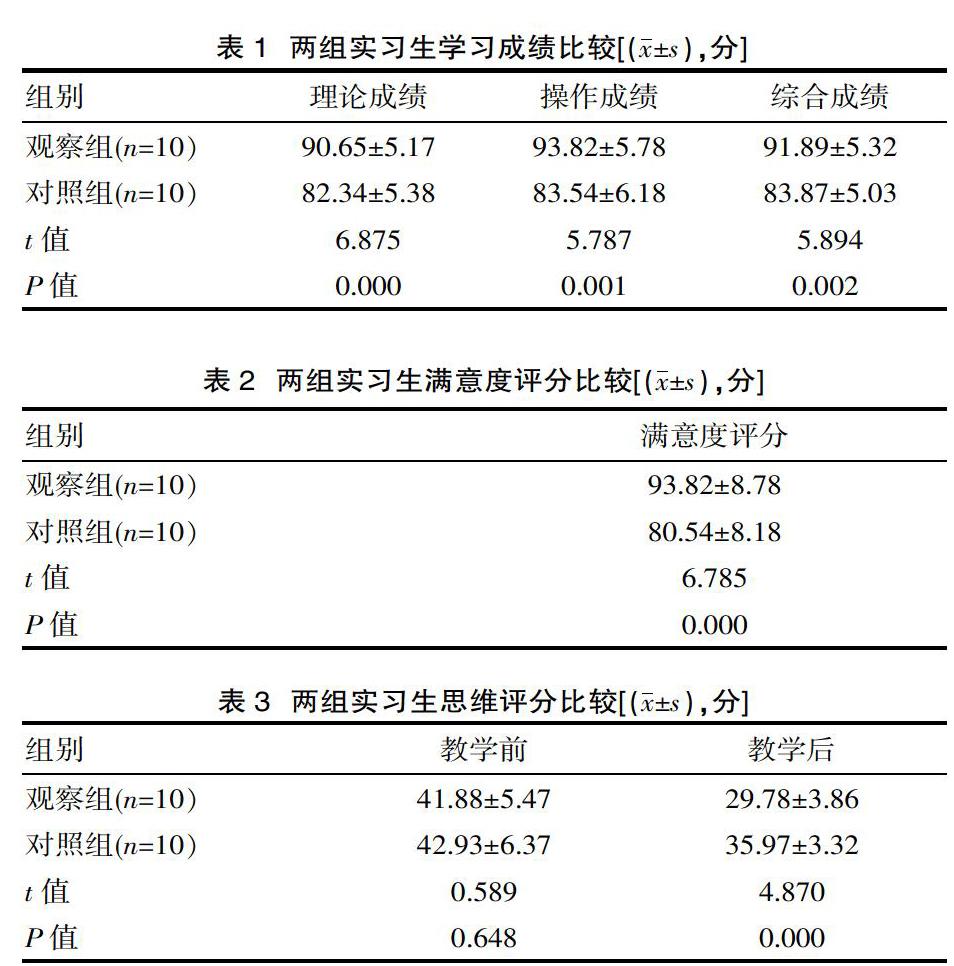
[摘要] 目的 探討兒童醫(yī)院神經(jīng)內(nèi)科帶教中存在的問(wèn)題及應(yīng)對(duì)策略。方法 該研究設(shè)計(jì)對(duì)象為2017年12月—2018年12月兒童醫(yī)院神經(jīng)內(nèi)科實(shí)習(xí)學(xué)生20名,隨機(jī)分為對(duì)照組與觀察組,各10名,給予對(duì)照組傳統(tǒng)教學(xué),給予觀察組改革帶教管理。對(duì)比兩組實(shí)習(xí)生的考核成績(jī)、滿(mǎn)意度評(píng)價(jià)、思維評(píng)分。結(jié)果 觀察組實(shí)習(xí)生的理論成績(jī)、操作成績(jī)、綜合成績(jī)均高于對(duì)照組,差異有統(tǒng)計(jì)學(xué)意義(P<0.05)。觀察組實(shí)習(xí)生的滿(mǎn)意度評(píng)分高于對(duì)照組,差異有統(tǒng)計(jì)學(xué)意義(P<0.05)。觀察組實(shí)習(xí)生教學(xué)后的思維評(píng)分低于對(duì)照組,差異有統(tǒng)計(jì)學(xué)意義(P<0.05)。結(jié)論 在兒童醫(yī)院神經(jīng)內(nèi)科帶教中應(yīng)用改革帶教管理,有效提高學(xué)生學(xué)習(xí)成績(jī),改善思維能力,得到滿(mǎn)意評(píng)價(jià),應(yīng)用價(jià)值高。
[關(guān)鍵詞] 兒童醫(yī)院;神經(jīng)內(nèi)科;帶教;實(shí)習(xí);教學(xué)管理
[中圖分類(lèi)號(hào)] R72;R856.5 [文獻(xiàn)標(biāo)識(shí)碼] A [文章編號(hào)] 1672-5654(2020)02(b)-0115-03
[Abstract] Objective To explore the existing problems and coping strategies in neurology teaching in children's hospital. Methods The research design object was 20 December 2017 to December 2018 children's hospital neurology internship students, randomly divided into control group and observation group, each group of 10, given the traditional teaching of the control group, the observation group reform teaching management. The assessment results, satisfaction evaluation and thinking score of the two groups of interns were compared for statistical analysis. Results The theoretical, operational and comprehensive scores of the interns in the observation group were higher than those in the control group, and the differences were statistically significant(P<0.05). The satisfaction score of the intern in the observation group was higher than that in the control group, and the difference was statistically significant(P<0.05). The observation group's thinking score after teaching was lower than that of the control group, and the difference was statistically significant (P<0.05). Conclusion The application of reform teaching management in the teaching of neurology in children's hospital can effectively improve students' academic performance, improve their thinking ability, obtain satisfactory evaluation, and have high application value.
[Key words] Children's Hospital; Department of Neurology; Teaching; Internship; Teaching management
臨床教學(xué)是醫(yī)學(xué)教育中一個(gè)重要環(huán)節(jié),屬于醫(yī)學(xué)教育重要組成部分[1]。近年來(lái),隨著全球教育規(guī)模不斷擴(kuò)大,對(duì)臨床教學(xué)質(zhì)量提出更高要求,而醫(yī)院需加強(qiáng)培養(yǎng)護(hù)理創(chuàng)新型人才,在重視呼聲操作技能與力量知識(shí)的基礎(chǔ)上,還應(yīng)當(dāng)注重創(chuàng)新思維。在傳統(tǒng)的教育模式以灌輸式學(xué)習(xí),教育內(nèi)容死板,教育方法單一,降低學(xué)生學(xué)習(xí)積極性,不利于學(xué)習(xí)成績(jī)提高,以及培養(yǎng)創(chuàng)新思維。因此,需不斷創(chuàng)新改革帶教管理。該研究以2017年12月—2018年12月兒童醫(yī)院神經(jīng)內(nèi)科實(shí)習(xí)學(xué)生20名為研究對(duì)象,探究?jī)和t(yī)院神經(jīng)內(nèi)科臨床帶教中存在的問(wèn)題及應(yīng)對(duì)策略。報(bào)道如下。
1? 資料與方法
1.1? 一般資料
該研究設(shè)計(jì)對(duì)象為兒童醫(yī)院神經(jīng)內(nèi)科實(shí)習(xí)學(xué)生20名,隨機(jī)分為對(duì)照組與觀察組,各10名。其中對(duì)照組,男、女分別為6名與4名,年齡19~23歲,平均年齡(22.56±0.31)歲;觀察組,男、女分別為4名與6名,年齡18~24歲,平均年齡(22.65±0.42)歲。學(xué)生基本信息差異無(wú)統(tǒng)計(jì)學(xué)意義(P>0.05)。具有可比性。
1.2? 教學(xué)方法
登錄APP查看全文
猜你喜歡
四川工商學(xué)院學(xué)術(shù)新視野(2021年2期)2021-11-02 06:16:28
大學(xué)(2021年2期)2021-06-11 01:13:24
甘肅教育(2020年17期)2020-10-28 09:01:24
甘肅教育(2020年4期)2020-09-11 07:41:24
現(xiàn)代職業(yè)教育·高職高專(zhuān)(2017年12期)2017-07-09 19:04:57
文學(xué)教育(2016年27期)2016-02-28 02:35:32
文學(xué)教育(2016年27期)2016-02-28 02:35:28
中國(guó)教育技術(shù)裝備(2015年10期)2015-03-01 02:41:04
河南科技(2014年8期)2014-02-27 14:08:17
體育師友(2011年2期)2011-03-20 15:29:29