羅哌卡因不同注藥速度對超聲聯合神經刺激儀引導鎖骨上臂叢神經阻滯術后鎮痛效果的影響
2020-10-29 05:38:50香效明楊智學林有梅周小敏
醫學信息
2020年18期
關鍵詞:羅哌卡因
香效明 楊智學 林有梅 周小敏
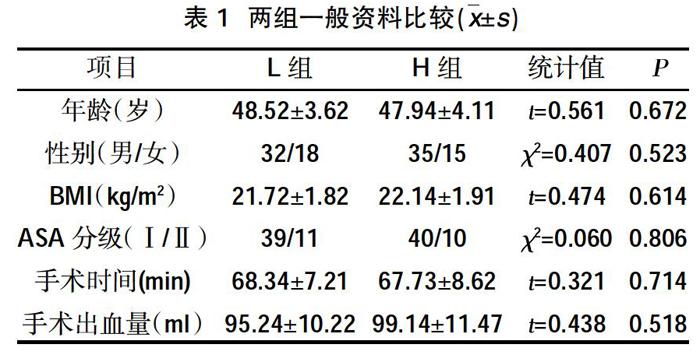
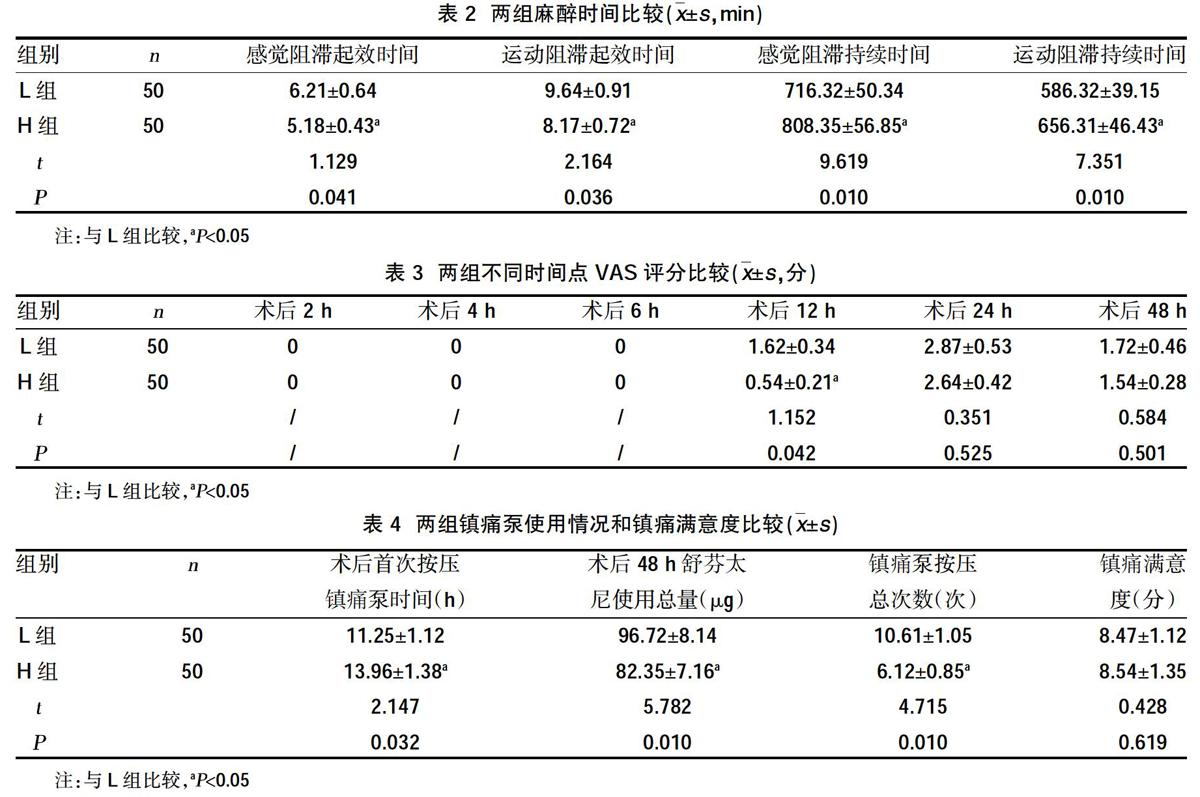
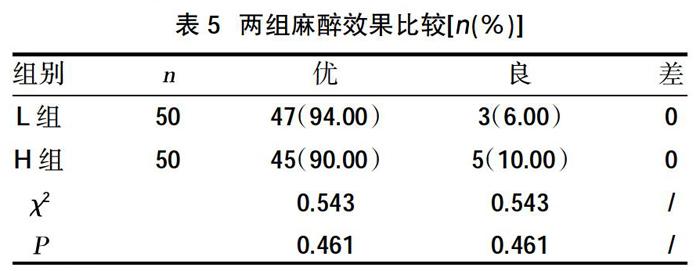
摘要:目的 ?探討0.375%羅哌卡因不同注藥速度對超聲聯合神經刺激儀引導鎖骨上臂叢神經阻滯術后鎮痛效果的影響。方法 ?選擇我院2017年5月~2020年5月擇期行單側上肢骨折內固定手術患者100例作為研究對象,隨機分為低速組(L組)和高速組(H組),各50例,兩組患者均采用超聲聯合神經刺激儀引導鎖骨上臂叢神經阻滯,注射0.375%羅哌卡因30 ml,L組注藥速度為20 ml/h,H組注藥速度為40 ml/h。比較兩組感覺阻滯起效時間、運動阻滯起效時間、感覺阻滯持續時間、運動阻滯持續時間、麻醉效果、術后2、4、6、12、24、48 h VAS評分;記錄兩組術后首次按壓鎮痛泵時間、術后48 h舒芬太尼使用量、鎮痛泵按壓總次數、鎮痛滿意度、臂叢神經阻滯并發癥和鎮痛相關并發癥發生率。結果 ?H組感覺阻滯起效時間、運動阻滯起效時間短于L組(P<0.05),且H組感覺阻滯持續時間、運動阻滯持續時間長于L組(P<0.05);兩組麻醉效果比較,差異無統計學意義(P>0.05);H組術后12 h VAS評分低于L組(P<0.05),其余時間點兩組VAS評分比較,差異無統計學意義(P>0.05);H組術后48 h舒芬太尼使用量、鎮痛泵按壓總次數低于L組(P<0.05),術后首次按壓鎮痛泵時間長于L組(P<0.05);兩組患者鎮痛滿意度比較,差異無統計學意義(P>0.05);兩組均未發生臂叢神經阻滯及鎮痛相關并發癥。結論 ?0.375%羅哌卡因注藥速度是影響雙重引導鎖骨上臂叢神經阻滯術后鎮痛效果的因素之一,與20 ml/min注藥速度相比,40 ml/min注藥速度起效時間更短,維持時間更長,術后鎮痛效果更佳,持續時間更長,術后舒芬太尼用量少,且不會增加阻滯相關并發癥的發生率。
關鍵詞:羅哌卡因;注藥速度;超聲;神經刺激儀引導;鎖骨上臂叢神經阻滯;術后鎮痛
中圖分類號:R614 ? ? ? ? ? ? ? ? ? ? ? ? ? ? ? ? ?文獻標識碼:A ? ? ? ? ? ? ? ? ? ? ? ? ? ? ? ? ?DOI:10.3969/j.issn.1006-1959.2020.18.021
文章編號:1006-1959(2020)18-0069-04
Effects of Different Injection Speeds of Ropivacaine on the Analgesic Effect of Supraclavicular
Brachial Plexus Block Guided by Ultrasound Combined with Neurostimulator
XIANG Xiao-ming,YANG Zhi-xue,LIN You-mei,ZHOU Xiao-min
(Department of Anesthesiology,Hengli Hospital,Dongguan 523460,Guangdong,China)
Abstract:Objective ?To explore the effect of different injection speeds of 0.375% ropivacaine on the analgesic effect of supraclavicular brachial plexus block guided by ultrasound combined with neurostimulator.Methods ?100 patients with elective internal fixation of unilateral upper limb fractures in our hospital from May 2017 to May 2020 were selected as the research objects. They were randomly divided into low-speed group (L group) and high-speed group (H group), with 50 cases in each. Both groups of patients were guided by ultrasound combined with nerve stimulator to guide supraclavicular brachial plexus nerve block, and injected 0.375% ropivacaine 30 ml, the injection rate of group L was 20 ml/h, and the injection rate of group H was 40 ml/h. Compare the onset time of sensory block, the onset time of motor block, the duration of sensory block, the duration of motor block, the effect of anesthesia, and the VAS scores at 2, 4, 6, 12, 24, and 48 h after operation between the two groups; The time of first pressing the analgesic pump after operation, the amount of sufentanil used 48 h after the operation, the total number of analgesic pump pressings, the satisfaction degree of analgesia, the complications of brachial plexus block and the incidence of analgesia-related complications in the two groups. Results ?The onset time of sensory block and motor block in group H was shorter than that in group L (P<0.05), and the duration of sensory block and motor block in group H was longer than that in group L (P<0.05); There was no statistically significant difference in the effect of anesthesia (P>0.05); the VAS score of the H group was lower than that of the L group at 12 h after the operation (P<0.05), and there was no significant difference in the VAS score between the two groups at other time points (P>0.05); 48 h after surgery, the amount of sufentanil used and the total number of compressions of the analgesic pump in the H group were lower than those in the L group (P<0.05), and the first compression of the analgesic pump after surgery was longer than that of the L group (P<0.05); There was no significant difference in satisfaction with analgesia between the two groups (P>0.05); there was no brachial plexus block and analgesia-related complications in the two groups.Conclusion ?The injection rate of 0.375% ropivacaine was one of the factors affecting the postoperative analgesic effect of dual-guided supraclavicular brachial plexus block. Compared with the injection rate of 20 ml/min, the injection rate of 40 ml/min was effective time was shorter, the maintenance time was longer, the postoperative analgesia effect was better, the duration was longer, the postoperative sufentanil dosage was less, and the incidence of block-related complications would not increase.
Key words:Ropivacaine;Injection speed;Ultrasound;Guidance by nerve stimulator;Supraclavicular brachial plexus block;Postoperative analgesia
臂叢神經阻滯是上肢手術麻醉常用方法,根據解剖學特征和注藥靶點可分為肌間溝臂叢神經阻滯、鎖骨上臂叢神經阻滯、鎖骨下臂叢神經阻滯、腋路臂叢神經阻滯等多種入路[1-3]。……
登錄APP查看全文
猜你喜歡
中外醫學研究(2017年1期)2017-02-23 13:45:38
中國實用醫藥(2016年30期)2016-12-28 09:05:20
今日健康(2016年12期)2016-11-17 12:00:55
中國實用醫藥(2016年26期)2016-11-07 13:36:00
中國實用醫藥(2016年19期)2016-08-05 22:00:33
上海醫藥(2016年13期)2016-07-26 23:07:51
中國實用醫藥(2016年13期)2016-07-05 09:17:55
中國實用醫藥(2016年1期)2016-01-11 11:38:53
現代儀器與醫療(2015年2期)2015-12-03 13:27:31
中國當代醫藥(2015年20期)2015-09-11 18:39:31