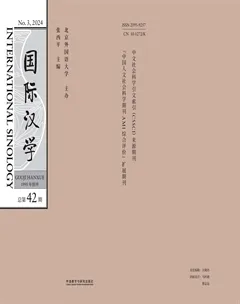
英文目錄與摘要
2024-08-14 00:00:00
國際漢學 2024年3期
關鍵詞:英文
Special Section
Homer in China Before May-Fourth Movement ···································· Li Shixue, Li Yiqing Crystal( 7 )
Studies on Literature and History
The Historiographical Theoretical Dimension of Shiji Studies in America: An Analysis on Grant R. Hardy’s
Worlds of Bronze and Bamboo: Sima Qian’s Conquest of History ··························Zhuang Yaqiong( 22 )
The Overseas Chinese Scholar Char Tin-Yuke and His Research on the History of Overseas Chinese
····················································································································Li Ruipu( 28 )
Special Column: Oral History of Sinologists
Tradition and Evolution of Nepalese Sinology ·············································· Fan Ziqi, Xu Baofeng( 38 )
Exploration of Spanish Sinologist Alicia Relinque Eleta’s Translation of Chinese Classics and Her
Sinological Studies ······················································································ Zhou Sirui( 46 )
A Review of the Studies of Indian Sinologist Tan Chung ·············································Xu Donghao( 58 )
Chinese Classics Overseas
A Preliminary Study on the German Translation of Excerpts of Shuoyuan and Xinxu ···················Ke Hui( 64 )
An Analysis of Li Jingyu’s Poems Using the Rhyme Sequence of Li Bai in the Joseon Dynasty························································································ Wang Hongxia, Yu Xiaohuo( 70 )
Sino-Foreign Cultural Exchanges
A Study on the Spread and Use of Western Woolen Goods Centered on Inventories of Property in the Qianlong Reign ···························································································Li Kun( 79 )
The Dissemination and Variation of Chinese Red Cliff Porcelain Images in Europe in the 17th and 18th Centuries ······················································································· Wang Wenxin( 94 )
Sinologists’ Specialization
Rediscovery of the Italian Sinologist Ludovico Luigi Nicola di Giura ··············Wang Jinxiao, Wen Zheng(104)
A Preliminary Study of American Sinologist Beata Grant’s Chinese Women Studies
························································································ Dang Congxin, Li Yongping(113)
The Interpretive Approach in American Contemporary Sinologist Sarah A. Queen’s Studies of Early Chinese Classics ·················································································Chen Jirong(121)
Column of “International Chinese Education” Sponsored by International Society for Chinese Language Teaching On the Dissemination of the Chinese Language in English Periodicals in the 19th Century
··········································································· Shen Ling, Fang Huanhai, Ma Ningxin(128)
Scholars and Book Reviews
Translator’s Freedom
—British Sinologist John Minford on Strange Tales from a Chinese Studio and Its Translation
····················································································Wang Xiao, (UK) John Minford(136)
Academic Trends
A Brief History of Tibetan Studies at Toyo Bunko ·············································Wang Li, Cao Yang(142)
Afterword
International Chinese Studies as a Study of Mutual Learning among Civilizations ··············Zhang Xiping(150)
Abstracts(No. 3, 2024)
Homer in China Before May-Fourth Movement
Li Shixue, Li Yiqing Crystal
Abstract: Homer is generally taken as one of the most representative poets in the West. It was not, however,until twenty-first centuries that Homer attracted the attention of Chinese readers. In the late Ming and the earlyQing dynasties, Jesuit missionaries Alfonso Vagnone and Joseph Prémare mentioned Homer, alluding to him byhis Italian or Latin names. In the late Qing dynasty, Homer’s name was translated into Chinese in various ways.Today he is best known by the name in the Chinese characters which Liang Qichao used. Similarly, the genre ofepic, known in Mandarin as shishi, remained unknown until the late Qing dynasty, when Wilhelm Lobscheid, aGerman missionary, began to translate the Meriam Webster Dictionary into Chinese. The term shishi returned toChina through the Japanese borrowing of it in the late nineteenth century. A few short segments of the Homericepics were rendered into Chinese in the late Ming and late Qing periods. Given source studies as the majorapproach to Homeric problems in pre-modern China, however, there was no scholarship on Homer in Chineseuntil the early Republican era.
Key words: Homer, shishi, Iliad, Odyssey, Zhou Zuoren
The Historiographical Theoretical Dimension of Shiji Studies in America: An Analysis onGrant R. Hardy’s Worlds of Bronze and Bamboo: Sima Qian’s Conquest of History
Zhuang Yaqiong
Abstract: As one of the representative works of Shiji studies in America, Grant R. Hardy’s Worlds of Bronzeand Bamboo: Sima Qian’s Conquest of History expands Western Shiji studies from multiple dimensions such asresearch directions, the annals-biography style, and comparative methods of Chinese and Western historiography.Grant R. Hardy’s studies of Shiji focus on its historical interpretation methods and historiographical objectives,which have a clear dimension of historiographical theoretical research, and have important reference value forpromoting exchanges and mutual learning between Chinese and Western historiography.
Key words: Grant R. Hardy, Worlds of Bronze and Bamboo: Sima Qian’s Conquest of History, AmericanSinology, studies of Shiji
The Overseas Chinese Scholar Char Tin-Yuke and His Research on theHistory of Overseas Chinese
Li Ruipu
Abstract: Char Tin-Yuke’s research on the history of overseas Chinese originated from his exploration ofthe origins of the Hakkas, and then advanced with his research on the history of overseas Chinese in Hawaii. Hebelieves that the shortage of labor in Hawaii’s sugarcane farming and sugar industry, as well as the continuoussocial unrest in South China, were the reasons for some Chinese people’s migration to Hawaii, where the Chinesehave made important contributions to the local economic development, and have adopted the local lifestyle whileretaining their traditional customs. Hawaiian authorities promulgated entry restriction on Chinese to reduce their"influence. Char Tin-Yuke takes the restrictive laws on Chinese in Pacific countries as an example to illustrate theinstitutional restrictions that Chinese people suffered in such aspects as voting right, land ownership and careerchoice. He attaches importance to the use of previous research results to serve his research theme, and enriches hisresearch contents with diverse historical materials. He is one of the first historians to write in English the historyof overseas Chinese in Hawaii and the Pacific Region.
Key words: Char Tin-Yuke, history of overseas Chinese, overseas Chinese in Hawaii
Tradition and Evolution of Nepalese Sinology
Fan Ziqi, Xu Baofeng
Abstract: Based on an in-depth analysis of Chinese and Nepali literature, this paper discusses in detail thehistory of Sino-Nepali exchanges and the development of Sinology in Nepal. It also systematically introduces thehistorical tradition and contemporary evolution of Sinological studies in Nepal. Because of the historical originsof the two countries, Nepal has a unique research advantage in early bilateral relations and Buddhist culturalexchanges, which led to excellent academic achievements of Nepalese Sinology in its embryonic stage, andcontributed to the formation of a research tradition centered on historical investigation. In the early 21st century,Nepalese Sinology began to develop rapidly, and its fields of concern extended from the history of bilateralrelations to Chinese society, economy, diplomacy, culture and other aspects, with more specific research methodsand perspectives.
Key words: Nepalese Sinology, history of China-Nepal relations, Chinese studies in Nepal
Exploration of Spanish Sinologist Alicia Relinque Eleta’s Translation of ChineseClassics and Her Sinological Studies
Zhou Sirui
Abstract: Alicia Relinque Eleta is a representative figure in contemporary Spanish Sinology, and she iscredited with the first translation of classical works such as The Literary Mind and the Carving of Dragons, PeonyPavilion and Story of the Western Chamber. Through oral history interviews combined with a literature review,this paper discusses her translation practices for classical books and her way of Sinological research in order toenrich contemporary Sinological research in Spain. In terms of translation practice, Relinque highlights an in-depthelucidation of the source-culture implications, accentuates the aesthetic values of Chinese culture, and explores thecontemporary adaptation of traditional culture to devise innovative and effective means for its transmission to thepresent era. In terms of Sinology research, she navigates between Chinese and Spanish cultures across diverse fields,facilitates academic and cultural communication, and expands the influence of Sinology in Spain.
Key words: Spanish Sinology, Alicia Relinque Eleta, Chinese classical works, translation
A Review of the Studies of Indian Sinologist Tan Chung
Xu Donghao
Abstracts: This paper aims to explore the important contributions of Tan Chung, a contemporary IndianSinologist, in the cultural exchange between China and India. Thanks to his family background, he becomesan outstanding representative of Sino-Indian cultural exchanges with his Chinese language skills. His research"has covered a wide range of fields. Through an analysis of his research and writings, we can understand hiscontributions to the dissemination of Chinese history, literature and ancient culture, which has provided valuableknowledge and perspective for the two peoples and promoted mutual understanding and friendship betweenthem. His achievements have not only been widely recognized in the academic community, but also laid a solidfoundation for the friendly relations and mutually beneficial cooperation between China and India.
Key words: Tan Chung, India Sinology, Sino-Indian exchanges
A Preliminary Study on the German Translation of Excerpts of Shuoyuan and Xinxu
Ke Hui
Abstract: The German translation of excerpts of Shuo Yuan and Xin Xu was published in the Germanversion of Description géographique, historique, chronologique, politique, et physique de l’empire de la Chine inthe middle of the 18th century. The translation of these excerpts is faithful to but shorter than the original Frenchversion. There are in total 11 stories, 10 of which are related to “politics” and one to “virtue”. In the early 19thcentury, Johann Gottfried Herder, a German Enlightenment thinker, published Adrastea, a cultural periodical, inwhich there were four new stories from Shuo Yuan and Xin Xu about “advice”, which were translated by Herder. Theintroduction of this German translation of excerpts met the intellectual needs of ordinary readers in German-speakingareas, and at the same time reflected the academic interest of German translators. In particular, Herder, who compiledand supplemented the stories, was an unexpected disseminator of Chinese culture.
Key words: Shuo Yuan, Xin Xu, Description de la Chine, German translation of excerpts, J. G. Herder
An Analysis of Li Jingyu’s Poems Using the Rhyme Sequence of Li Bai in the Joseon Dynasty
Wang Hongxia, Yu Xiaohuo
Abstract: Li Bai had a great influence on the poetry of later generations and literati in the Joseon dynastyof Korea. Li Jingyu was one of Korean scholars. Of the 40 surviving five-character poems by Li Jingyu, 14 usethe rhyme sequence of Li Bai. They are also influenced by Li Bai’s poems in terms of subject matter, content andideological meaning, but on the other hand, they have the characteristics of “learning from Li but not being limitedto him”. This article takes these 14 rhymed poems as the starting point, and through close reading explores thecharacteristics of and reasons for Li Jingyu’s use of the rhyme sequence of Li Bai’s poems.
Key words: the Joseon dynasty of Korea, Li Jingyu, use of rhymes of another’s poetry, Li Bai
A Study on the Spread and Use of Western Woolen Goods Centered on Inventories ofProperty in the Qianlong Reign
Li Kun
Abstract: This study investigates the spread and use of Western woolen goods in the early and middleQing dynasty by using 104 inventories of property and related historical materials. The study finds that as earlyas the Qianlong reign, the geographically Western woolen goods were spread throughout the country, and evenlow-level officials in remote areas possessed Western woolen goods, which were transported and sold in variousparts of the country through officials and merchants. Western woolen goods were used to make clothing such ascivilian clothes, traveling outfits and official uniforms; household items such as quilts, bed blankets, carpets, chair
cushions and table mats; accessories such as purses, pockets and hats; and rain gear such as raincoats and rainhats. They were also used as gifts. However, they were luxuries in the early and middle Qing dynasty, only spreadamong groups with strong financial strength, such as officials and wealthy businessmen.
Key words: Qianlong Reign, Western woolen goods, inventories of property
The Dissemination and Variation of Chinese Red Cliff Porcelain Images inEurope in the 17th and 18th Centuries
Wang Wenxin
Abstract: In the middle and late Ming dynasty, there appeared a kind of daily-use porcelain with images ofDongpo’s night tour in Red Cliff and inscriptions of the long poem “Ode to Red Cliff”. This kind of porcelain,fired for the local market, entered the list of commodities exported to Europe and other parts of the world. Thispaper places Red Cliff porcelain and its images in the context of cross-cultural communication, and discusses thepaths of transmission and variation of Red Cliff porcelain images in the 17th and 18th centuries in combinationwith existing artifacts, book illustrations, archaeological reports, and descriptions of the collections of institutions.In particular, it pays attention to the historical contexts of these transmissions and variations, and the imaginationand misinterpretation during cultural communication.
Key words: Red Cliff porcelains, image dissemination, image variation, cross-cultural communication
Rediscovery of the Italian Sinologist Ludovico Luigi Nicola di Giura
Wang Jinxiao, Wen Zheng
Abstract: Based on first-hand data recently discovered and cataloged from the private collection of theItalian Sinologist Ludovico Luigi Nicola di Giura in his former residence and historical documents collected inthe official archives of China and Italy, this paper recounts di Giura’s experience and travels in China, interpretsthe contents of his works, presents his writing process, and analyzes the underlying thoughts, so as to re-evaluatethis historical figure and his contribution to Sinology. During his stay in China, di Giura, with his medical skillsand his interest in Chinese culture, not only successfully integrated into Chinese social life, but also gained widerecognition among the people, and even became one of the Europeans closest to the power and cultural centerof China in the late Qing dynasty and the early Republican era. He had close contacts with the imperial family,political figures and cultural elites in Beijing. His multiple identities and rich experiences can provide detailedinformation and fresh ideas for the study of the history of Sino-Italian cultural exchange in modern times, of thespread of Chinese literature outside the region, and of the dissemination of Western medicine in China.
Key words: Ludovico Luigi Nicola di Giura, history of Sino-Italian relations, Sino-Italian cultural exchange,Italian Sinology, translation of classical Chinese literature
A Preliminary Study of American Sinologist Beata Grant’s Chinese Women Studies
Dang Congxin, Li Yongping
Abstract: Taking women studies as the starting point, Beata Grant conducted an investigation into thereligious life of traditional Chinese women under the dual research path of understanding “religion for women”and “women for religion”. Using materials written by Chinese women, she discovers the inner spirit and"self-identity of women in Chinese Buddhist culture, explores the history of the creation of Buddhist women’spoetry and of female communication, reconstructs the real-life context of these women, and restores theirsubjectivity in Buddhist history. Accordingly, Grant uses her “Chinese experience” of Chinese women studiesas an ideological and cultural resource, and combines cross-cultural perspectives, common expressions andobservation of the mainstream from the edge to deal with the dilemma of Western women studies.
Key words: Beata Grant, Chinese women, faith, Buddhist nuns, women studies
The Interpretive Approach in American Contemporary SinologistSarah A. Queen’s Studies of Early Chinese Classics
Chen Jirong
Abstract: Sarah A. Queen, an American Sinologist, has made remarkable achievements in both theoreticalresearch and translation of early Chinese classics. This article makes a comprehensive analysis and interpretationof Queen through her thematic research, especially her methods of interpretation of early Chinese classics.Through induction and contrast, this study divides Queen’s interpretative methods of early Chinese classics intothree levels: exegesis, rhetoric and translation, and discusses them in combination with cultural practice, historicalbackground, rhetorical narrative and translation comparison, in order to provide a new perspective for domesticscholars to understand overseas studies of early Chinese classics.
Key words: American Sinologist, Sarah A. Queen, Chinese classics, the interpretive approach
On the Dissemination of the Chinese Language in English Periodicals in the 19th Century
Shen Ling, Fang Huanhai, Ma Ningxin
Abstract: This paper conducts a quantitative analysis of documents relevant to the Chinese languagein the Periodicals Archive Online (PAO), and reveals the annual trend of attention to the Chinese language inEnglish periodicals in the 19th century. According to the records and descriptions of the Chinese language inEnglish periodicals in the 19th century, this study, by combining diachronic display and synchronic comparison,summarizes the process of the understanding of Chinese language in China and the West in the course ofthe spread of Chinese language outside China in the 19th century, and analyzes the intrinsic mechanism ofdissemination of the Chinese language abroad.
Key words: Western Sinology, English periodicals, the communication of Chinese language at abroad
A Brief History of Tibetan Studies at Toyo Bunko
Wang Li, Cao Yang
Abstract: By using the method of literature research, this paper collects information about the developmentof Tibetology at Toyo Bunko, and divides the Tibetology research of Toyo Bunko into three periods: the initialperiod from 1940 to 1961, the flourishing period from 1961 to 1989, and the continued developmental periodfrom 1989 until today. On this basis, it analyzes the characteristics and influence of the research of Toyo BunkoTibetology, and the significance of Toyo Bunko’s valuable Tibetan resources, its rich Tibetology researchachievements and the development of Tibetology that can be used as reference for the development of Tibetologyresearch in China.
Key words: Japan, Toyo Bunko, Tibetan studies
猜你喜歡
國際展望(2017年2期)2017-03-21 18:34:18
鄱陽湖學刊(2016年6期)2017-01-16 13:05:41
中國遠程教育(2016年6期)2016-12-07 10:07:02
財經(2016年19期)2016-08-11 08:17:03
中國遠程教育(2016年5期)2016-06-29 10:13:42
中國遠程教育(2016年2期)2016-03-21 10:31:21
中國遠程教育(2016年1期)2016-02-26 10:37:15
國際展望(2015年5期)2015-09-15 05:41:45
國際展望(2015年4期)2015-07-13 05:30:56
能源(2014年9期)2014-09-15 13:18:12