探討新生兒早發(fā)型與晚發(fā)型敗血癥臨床特征
2015-08-29 20:14:48周炎娟張磊
中外醫(yī)療
2015年13期
關(guān)鍵詞:臨床特征
周炎娟 張磊
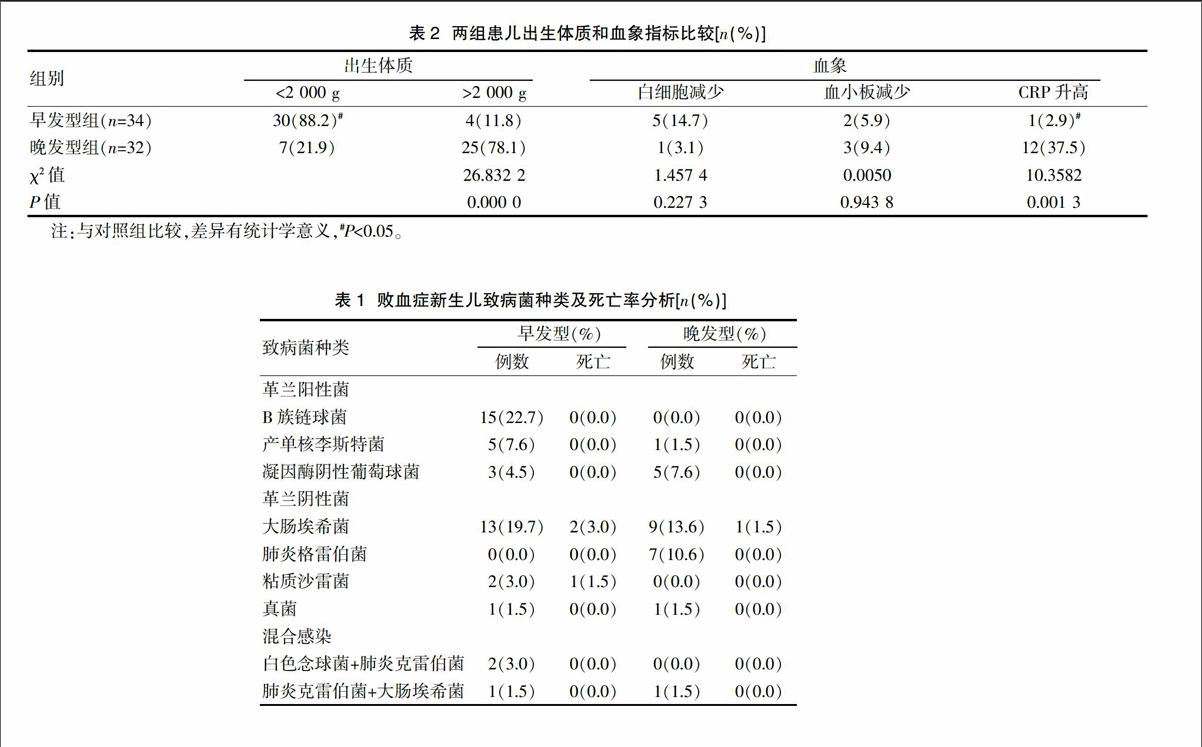
[摘要] 目的 探討新生兒早發(fā)型和晚發(fā)型敗血癥的臨床特征。 方法 選取該院2012年6月—2013年6月時(shí)間段內(nèi)收治的全部66例敗血癥新生兒作為研究對(duì)象,按照所有患兒出生年齡的不同將其分為早發(fā)型組(34例)和晚發(fā)型組(32例),并比較兩組患兒的臨床特征。 結(jié)果 早發(fā)型組中敗血癥患兒常為足月兒,晚發(fā)型組常為早產(chǎn)或極低體重患兒;早發(fā)型組中主要致病菌為大腸埃希菌13例和B族鏈球菌11例,晚發(fā)型組中多為肺炎克雷伯菌10例和大腸埃希菌9例。 結(jié)論 孕產(chǎn)婦產(chǎn)前積極進(jìn)行GBS和大腸埃希菌的篩查,并對(duì)GBS和大腸埃希菌檢查陽性產(chǎn)婦提前預(yù)防使用抗生素,將有益于降低早發(fā)型新生兒敗血癥。
[關(guān)鍵詞] 早發(fā)型;晚發(fā)型;敗血癥;臨床特征
[中圖分類號(hào)] R53 [文獻(xiàn)標(biāo)識(shí)碼] A [文章編號(hào)] 1674-0742(2015)05(a)-0021-02
To Investigate the Early-onset and Late-onset Neonatal Sepsis Clinical Features
ZHOU Yan-juan ZHANG Lei
1.NICU, Children's Eastern Hospital of Zhengzhou,Henan 450053,China;2.Respiratory Medicine, Children's Eastern Hospital of Zhengzhou,Henan Province,450053 China
[Abstract] Objective To investigate the clinical characteristics of early onset and late onset neonatal sepsis. Methods Our hospital in June 2012-June 2013 period were treated 66 cases of neonatal sepsis in the study, according to all the children born of different ages will be divided into early-onset group (34 cases) and late-onset group (32 cases), and compared the two groups of children with clinical features. Results A group of children with early-onset sepsis often full-term children, the late-onset group often premature delivery or low birth weight infants; early-onset group, 13 cases of major pathogenic Escherichia coli and group B streptococci in 11 cases, late hairstyle group mostly Klebsiella pneumoniae and Escherichia coli nine cases 10 cases.Conclusion Motherhood Maternity active before GBS screening and Escherichia coli, and E. coli test positive maternal GBS and the prophylactic use of antibiotics in advance, would be beneficial to reduce the early onset neonatal sepsis.
[Key words] Early onset; Late-onset; Septicemia; Clinical features
新生兒敗血癥是臨床新生兒童較為嚴(yán)重的一種感染性疾病,其致死率較高[1]。隨著感染時(shí)間及病房環(huán)境的不同,新生兒敗血癥的致病菌種類也可能有所不同[2]。該研究整群選取該院2012年6月—2013年6月時(shí)間段內(nèi)收治的66例敗血癥新生兒作為研究對(duì)象,探討新生兒早發(fā)型和晚發(fā)型敗血癥的臨床特征。現(xiàn)報(bào)道如下。
1 資料與方法
1.1 一般資料
整群選取該院收治的66例敗血癥新生兒作為研究對(duì)象,按照所有患兒出生年齡的不同將其分為早發(fā)型組(34例)和晚發(fā)型組(32例)。其中早發(fā)型組患兒男18例,女16例,年齡2~7 d,平均年齡(5.2±0.9)d;晚發(fā)型組患兒男15例,女17例,年齡7~28 d,平均年齡(15.1±1.3)d。
1.2 方法
所有新生兒均被確診為敗血癥,其診斷標(biāo)準(zhǔn)為患兒雙份血培養(yǎng)結(jié)果為陽性且表現(xiàn)出相關(guān)敗血癥的臨床癥狀,該標(biāo)準(zhǔn)符合“2003年中華醫(yī)學(xué)會(huì)兒科分會(huì)中新生兒組提出的有關(guān)新生兒敗血癥診斷標(biāo)準(zhǔn)”。……
登錄APP查看全文
猜你喜歡
上海醫(yī)藥(2016年23期)2016-12-22 12:37:08
中國(guó)現(xiàn)代醫(yī)生(2016年27期)2016-12-21 16:21:19
中國(guó)實(shí)用醫(yī)藥(2016年28期)2016-12-07 08:59:38
中國(guó)實(shí)用醫(yī)藥(2016年26期)2016-11-07 11:05:00
中國(guó)實(shí)用醫(yī)藥(2016年22期)2016-08-19 11:45:28
中國(guó)實(shí)用醫(yī)藥(2016年19期)2016-08-05 19:18:52
中國(guó)實(shí)用醫(yī)藥(2016年17期)2016-07-26 22:34:56
中國(guó)實(shí)用醫(yī)藥(2016年15期)2016-05-24 04:13:31
中國(guó)實(shí)用醫(yī)藥(2016年10期)2016-05-04 14:12:26
中國(guó)實(shí)用醫(yī)藥(2016年10期)2016-05-04 03:53:53