16排螺旋CT在顱內(nèi)腦膜瘤診斷中的應(yīng)用
2017-12-16 15:34:47王亮
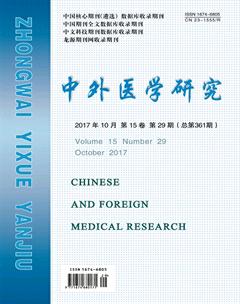
中外醫(yī)學(xué)研究
2017年29期
關(guān)鍵詞:診斷
王亮
【摘要】 目的:通過對顱內(nèi)腦膜瘤患者16排螺旋CT診斷結(jié)果進(jìn)行分析,探討16排螺旋CT在顱內(nèi)腦膜瘤診斷中的應(yīng)用價值。方法:采用回顧性分析的方法,分析2015年1月-2016年1月來筆者所在醫(yī)院就診的42例顱內(nèi)腦膜瘤患者的臨床資料。患者取仰臥位,采用16排螺旋CT機(jī),自頸前弓下緣至顱頂進(jìn)行頭部連續(xù)性薄層掃描。結(jié)果:腦膜瘤好發(fā)部位依次為大腦鐮旁、大腦凸面、蝶骨嵴、矢狀竇旁、小腦橋腦角、鞍區(qū);腫瘤大小分布特點,在5 cm以上患者3例,3~5 cm患者19例,3 cm以下患者20例;腫瘤形狀特點,類圓形或圓形27例,長條型或啞鈴型2例,不規(guī)則形13例。結(jié)論:16排螺旋CT在顱內(nèi)腦膜瘤診斷中具有重要的臨床意義,值得臨床廣泛應(yīng)用推廣。
【關(guān)鍵詞】 螺旋CT; 腦膜瘤; 診斷
doi:10.14033/j.cnki.cfmr.2017.29.036 文獻(xiàn)標(biāo)識碼 B 文章編號 1674-6805(2017)29-0073-02
16 Row Helical CT in the Diagnosis of Intracranial Meningiomas/WANG Liang.//Chinese and Foreign Medical Research,2017,15(29):73-74
【Abstract】 Objective:To explore the 16 row helical CT in the diagnosis of intracranial meningioma application value,through 16 row helical CT in patients with intracranial meningioma diagnosis analysis.Method:The retrospective analysis method was used,from January 2015 to January 2016,a year time to come to our hospital clinical data of 42 patients with intracranial meningiomas were studied.The patient supine position,used the 16 row helical CT machine,from the edge of anterior portion bow to parietal for continuous thin layer scanning head.Result:Meningiomas good location,in turn,was next to the falx cerebri,brain convex,sphenoid ridge,beside the sagittal sinus and cerebellopontine angle,and saddle area.Tumor size distribution characteristics,3 cases with more than 5 cm,
3-5 cm in 19 patients,incidence of 20 patients with 3 cm below.Characteristics of tumor shape,round or circular 27 cases,strip or dumbbell in 2 cases,13 cases of irregular shape.Conclusion:16 row helical CT in the diagnosis of intracranial meningioma has important clinical significance,and is worth wide application in the clinical practice.
【Key words】 Spiral CT; Meningioma; The diagnosis
First-authors address:Nanjing City Lishui District Peoples Hospital,Nanjing 211200,China
腦膜瘤是由顱內(nèi)蛛網(wǎng)膜細(xì)胞形成,源于腦膜和腦間隙的衍生物,腦膜瘤大多屬于良性腫瘤,主要表現(xiàn)為單發(fā),多發(fā)很少見。腦膜瘤具有生長緩慢,病程相對較長的特點[1-2]。顱內(nèi)腦膜瘤發(fā)病率較高,占顱內(nèi)腫瘤的15%~24%,是僅次于膠質(zhì)瘤而位居第二位顱內(nèi)良性腫瘤。腦膜瘤缺乏特異性的臨床表現(xiàn)和體征,因腫瘤呈現(xiàn)膨脹式生長,患者常以頭痛或者癲癇發(fā)作為首發(fā)臨床表現(xiàn)。早發(fā)現(xiàn)確診病癥對患者后期治療及預(yù)后有重要意義。近年來,對腦膜瘤診斷的研究越來越多,隨著科技不斷進(jìn)步,腦膜瘤診斷手段也越來越多。目前頭部超聲波、CT、MRI和血管造影等檢查是腦膜瘤診斷的重要手段,不但做出定性診斷,還可以明確顯示侵犯范圍,對選擇手術(shù)進(jìn)路有很大幫助。……
登錄APP查看全文
猜你喜歡
今日健康(2016年12期)2016-11-17 14:35:13
科技資訊(2016年18期)2016-11-15 18:11:12
科技資訊(2016年18期)2016-11-15 08:02:49
中國現(xiàn)代醫(yī)生(2016年23期)2016-11-15 03:16:01
法制博覽(2016年11期)2016-11-14 10:41:54
體育時空(2016年9期)2016-11-10 21:51:16
中國科技博覽(2016年19期)2016-10-19 13:05:18
中國科技博覽(2016年18期)2016-10-19 10:10:52
科技視界(2016年21期)2016-10-17 18:28:05
中國實用醫(yī)藥(2016年24期)2016-10-17 06:23:23