急診胸腹創(chuàng)傷手術(shù)后切口感染的相關(guān)因素調(diào)查
2020-06-11 00:37:01鄒樹(shù)林吳秋季張海軍劉福旭
中國(guó)衛(wèi)生產(chǎn)業(yè)
2020年7期
關(guān)鍵詞:切口感染危險(xiǎn)因素
鄒樹(shù)林 吳秋季 張海軍 劉福旭
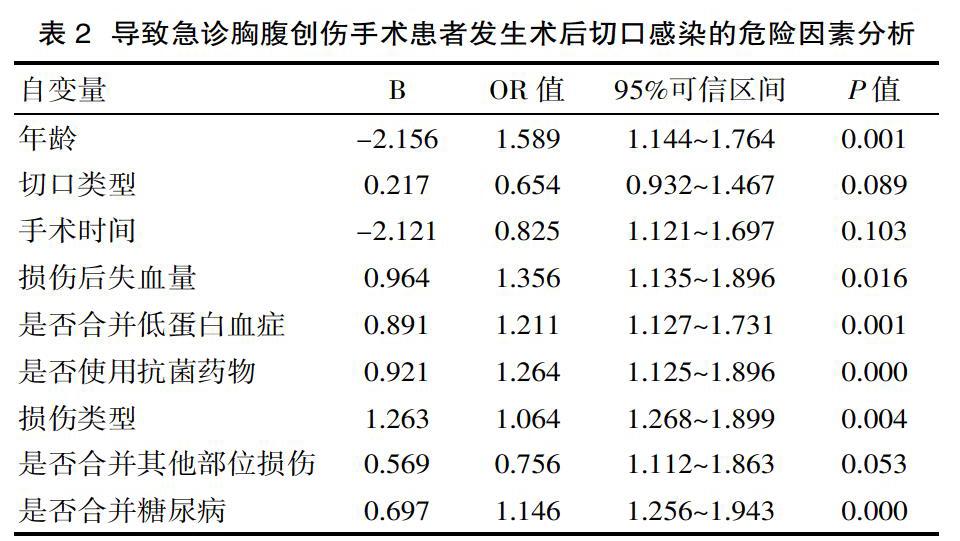
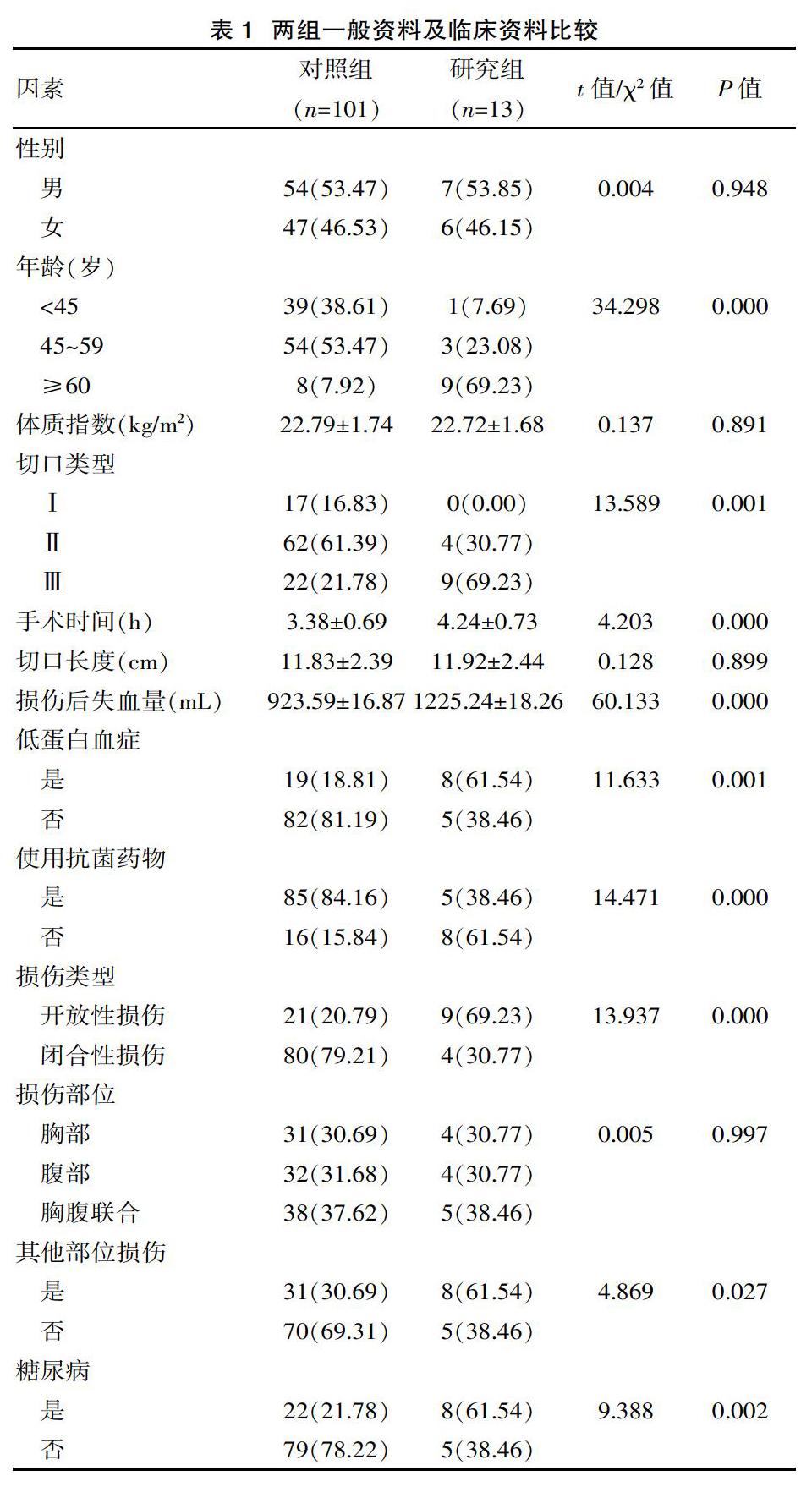
[摘要] 目的 研究急診胸腹創(chuàng)傷手術(shù)后切口感染的危險(xiǎn)因素。方法 將該院于2017年9月—2018年9月收治的114例急診胸腹創(chuàng)傷手術(shù)患者作為研究對(duì)象,根據(jù)患者是否發(fā)生術(shù)后切口感染分為研究組(發(fā)生術(shù)后切口感染)和對(duì)照組(未發(fā)生術(shù)后切口感染),統(tǒng)計(jì)并比較兩組患者的一般資料及臨床資料,同時(shí)分析導(dǎo)致急診胸腹創(chuàng)傷手術(shù)患者發(fā)生術(shù)后切口感染的危險(xiǎn)因素。結(jié)果 患者年齡大、損傷后失血量多、合并低蛋白血癥、未使用抗菌藥物、開(kāi)放性損傷以及合并糖尿病,均是急診胸腹創(chuàng)傷手術(shù)患者術(shù)后并發(fā)切口感染的危險(xiǎn)因素(P<0.05)。結(jié)論 患者年齡大、損傷后失血量多、合并低蛋白血癥、未使用抗菌藥物、開(kāi)放性損傷以及合并糖尿病,均是急診胸腹創(chuàng)傷手術(shù)患者術(shù)后并發(fā)切口感染的危險(xiǎn)因素。
[關(guān)鍵詞] 急診;胸腹部創(chuàng)傷;切口感染;危險(xiǎn)因素
[中圖分類(lèi)號(hào)] R656 [文獻(xiàn)標(biāo)識(shí)碼] A [文章編號(hào)] 1672-5654(2020)03(a)-0180-03
[Abstract] Objective To study the risk factors of incision infection after emergency thoracoabdominal trauma surgery. Methods A total of 114 emergency thoracoabdominal trauma patients treated in the hospital from September 2017 to September 2018 were taken as the research objects. The patients were divided into a study group (postoperative incision infection) and a control group (no postoperative incision infection occurred) according to whether the patients had postoperative incision infection. The general and clinical data of the two groups of patients were counted and compared. At the same time, the risk factors for postoperative incision infection in patients with thoracic and abdominal trauma were analyzed. Results The older the patients were, the more blood loss after injury they had, combined with hypoalbuminemia, did not use antibacterial drugs, open injuries, and were associated with diabetes, all of which were risk factors for incision infection after emergency thoracoabdominal trauma(P<0.05). Conclusion Patient age, high blood loss after injury, combined with hypoalbuminemia, non-use of antibacterial drugs, open injury, and diabetes mellitus are all risk factors for postoperative wound infection in patients with thoracic and abdominal trauma.
[Key words] Emergency; Chest and abdominal trauma; Incision infection; Risk factors
胸腹部創(chuàng)傷屬于較為嚴(yán)重的創(chuàng)傷,往往需要通過(guò)急診手術(shù)予以治療,然而手術(shù)治療后也較易發(fā)生術(shù)后切口感染,不利于患者預(yù)后,嚴(yán)重時(shí)更可危及患者生命安全[1]。因此,積極探究導(dǎo)致急診胸腹創(chuàng)傷手術(shù)患者發(fā)生術(shù)后切口感染的危險(xiǎn)因素,以便準(zhǔn)確評(píng)估急診胸腹創(chuàng)傷手術(shù)手術(shù)患者發(fā)生術(shù)后切口感染的危險(xiǎn)程度,盡早制定術(shù)后切口感染的預(yù)防措施,對(duì)改善急診胸腹創(chuàng)傷手術(shù)患者預(yù)后,促進(jìn)患者病情恢復(fù),具有重要意義。該文2017年9月—2018年9月間就通過(guò)對(duì)114例急診胸腹創(chuàng)傷手術(shù)患者的研究,分析了導(dǎo)致急診胸腹創(chuàng)傷手術(shù)患者發(fā)生術(shù)后切口感染的危險(xiǎn)因素,現(xiàn)報(bào)道如下。
1 ?對(duì)象與方法
1.1 ?研究對(duì)象
將該院收治的114例急診胸腹創(chuàng)傷手術(shù)患者作為研究對(duì)象。……
登錄APP查看全文
猜你喜歡
中國(guó)當(dāng)代醫(yī)藥(2016年30期)2017-01-07 00:45:41
中國(guó)實(shí)用醫(yī)藥(2016年29期)2016-12-26 10:10:31
中國(guó)實(shí)用醫(yī)藥(2016年23期)2016-12-26 09:59:59
今日健康(2016年12期)2016-11-17 14:41:50
今日健康(2016年12期)2016-11-17 13:12:34
今日健康(2016年12期)2016-11-17 12:29:29
科技資訊(2016年19期)2016-11-15 10:33:36
中國(guó)實(shí)用醫(yī)藥(2016年26期)2016-11-07 12:22:33
中國(guó)實(shí)用醫(yī)藥(2016年24期)2016-10-17 05:32:48
中國(guó)實(shí)用醫(yī)藥(2016年21期)2016-08-19 15:24:06